Warning Signs Your Tree Is Unhealthy (And What to Do About It in North Florida)

Most tree failures don't happen suddenly. They announce themselves — sometimes for years — through symptoms that go unrecognized until it's too late.
In my decade of work as an arborist in Tallahassee, the pattern I see most often isn't negligence. It's unfamiliarity. Most homeowners don't know what a healthy tree looks like at the physiological level, which means they have no reference point for recognizing when something has gone wrong. By the time a tree becomes obviously sick, the underlying problem has frequently been developing for multiple growing seasons.
North Florida's climate amplifies this challenge. Our combination of prolonged heat, periodic drought, heavy rainfall, and cyclical freeze events creates a stress profile unlike most of the country. The same tree that would thrive under consistent northern conditions may experience cumulative stress in our environment that, without intervention, becomes irreversible decline.
Here is what I look for during a tree health assessment.

1. Crown Dieback and Thinning Canopy
The canopy is the most immediate visual indicator of a tree's systemic health. A declining crown — characterized by dead branches at the periphery, progressive leaf loss from the tips inward, or a noticeably sparser canopy than previous seasons — signals that the tree's vascular system is struggling to deliver adequate water and nutrients to its outermost tissues.
In North Florida, crown dieback is frequently associated with root damage, whether from construction activity completed years earlier, soil compaction, grade changes, or cumulative drought stress. The roots are compromised first; the canopy reflects it last. This lag between cause and visible symptom is one reason arboricultural assessment should precede obvious decline rather than follow it.
2. Changes in Bark Texture and Integrity
Healthy bark functions as a protective organ. When that function is compromised — through fungal infection, mechanical damage, insect colonization, or internal decay — the changes become legible on the tree's surface.
Specific indicators I look for include cracking or separating bark that exposes the cambium layer beneath; cankers (sunken, discolored lesions on the bark surface); excessive resin or sap flow, particularly on pine species; and slime flux — a foul-smelling bacterial seepage associated with bacterial wetwood infection. Any of these in isolation warrants attention. Multiple observations on the same tree warrant urgency.
3. Fungal Growth at the Base
The presence of conk-forming fungi at the base of a tree — those shelf-like bracket formations commonly called shelf mushrooms — is among the most serious indicators I encounter in field assessments. These fruiting bodies are the visible expression of internal wood decay, often caused by root rot pathogens such as Ganoderma, Inonotus, or Armillaria species.
By the time bracket fungi are externally visible, the internal decay they indicate is frequently advanced. The critical implication for North Florida homeowners is structural: a tree that appears visually intact may have lost a significant proportion of its load-bearing wood. In a region where summer thunderstorms routinely generate 50+ mph wind gusts, the distinction between visual health and structural soundness is not academic.
4. Leaf Abnormalities
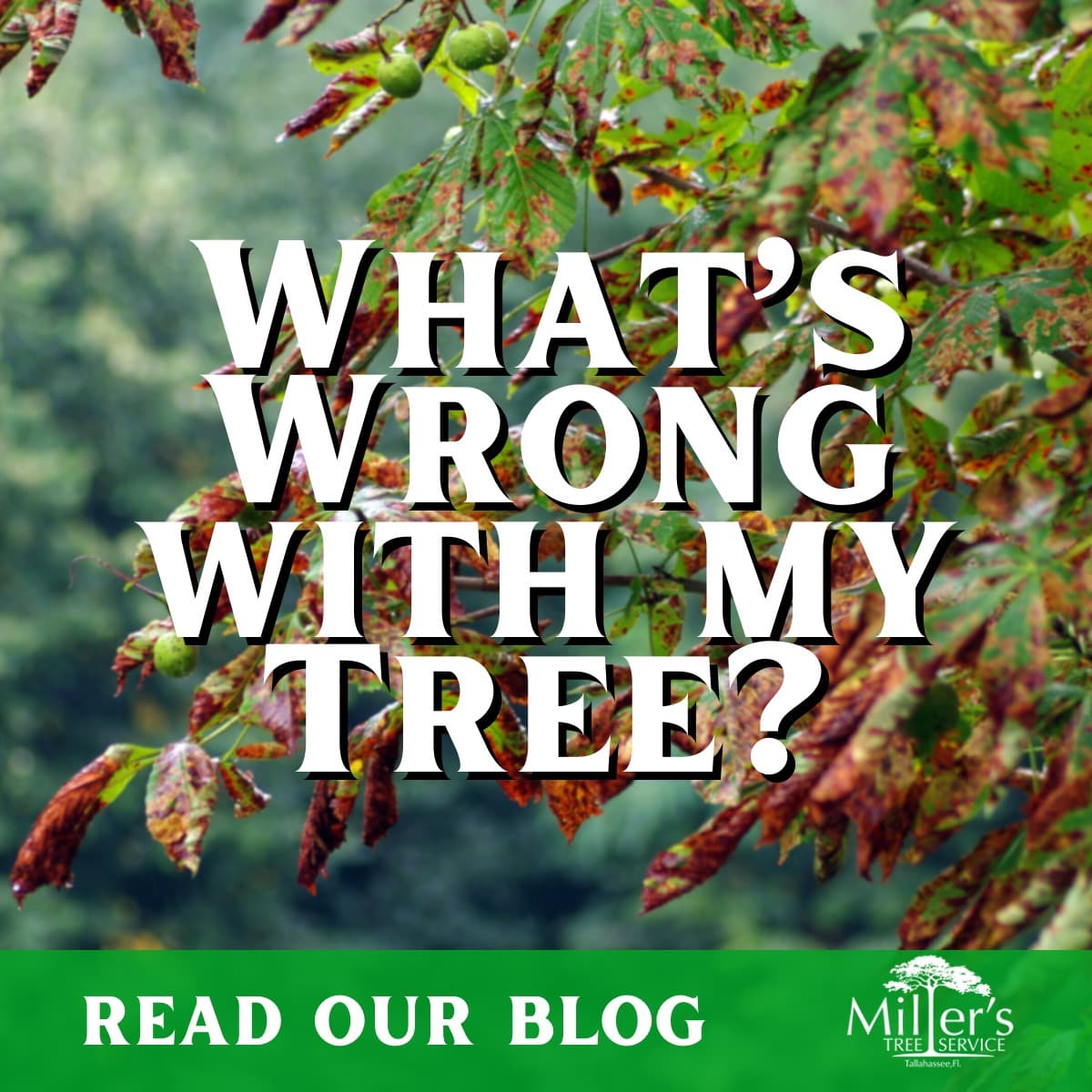
Leaves communicate a remarkable amount of diagnostic information. Premature yellowing outside the normal senescence calendar suggests nutrient deficiencies — manganese and iron deficiencies are common in North Florida's frequently alkaline soils. Unusual spotting, lesions, or distortion can indicate fungal pathogens, bacterial infections, or insect infestations including scale, whitefly, and various boring beetles.
Early and excessive leaf drop during the growing season is a particularly significant indicator. Unlike deciduous drop in autumn, stress-triggered defoliation in spring or summer reflects the tree's attempt to reduce its transpirational load — essentially, the tree is shedding leaves it can no longer support.
5. Root Zone Disturbance
The root zone — typically extending from the trunk to the drip line and beyond — is the most frequently overlooked component of tree health assessment. Root damage is invisible from above ground, which is precisely why it's so consequential.
Soil compaction from foot traffic, parking, or construction activity is one of the most pervasive threats to urban tree health in Tallahassee. Roots require gas exchange with the atmosphere; compacted soils restrict that exchange and reduce the tree's capacity to absorb water and nutrients. Freshly poured concrete, grade changes, and utility trenching within the root zone can trigger decline that appears years after the causative event — long after the connection becomes obvious.
What to Do If You Recognize These Signs
The earlier these indicators are identified, the larger the range of available interventions. Some conditions — certain fungal infections, nutrient deficiencies, compaction — are genuinely reversible with appropriate treatment. Others are progressive and irreversible; in those cases, the question becomes risk management rather than treatment.
I hold the ISA Tree Risk Assessment Qualification (TRAQ), which means my assessments go beyond general observation to formal structural evaluation. If you're uncertain about a tree's health or stability, a formal assessment produces a documented risk determination that informs your decision-making and provides meaningful documentation for your insurance carrier if a claim becomes necessary.
If you've noticed any of these warning signs on trees in your yard, contact Miller's Tree Service to schedule a free on-site consultation. Don't wait for the canopy to tell you something the roots have been communicating for years.
About the Author
Katie Watkins is a Sales Arborist at Miller's Tree Service in Tallahassee, FL, specializing in tree health care and helping customers make informed decisions about the long-term well-being of their trees. She holds her ISA Certified Arborist credential (FL10270A) and is Tree Risk Assessment Qualified (TRAQ) by the International Society of Arboriculture. Katie has been part of the Miller's team since 2015. Follow her on Instagram at @katiethetreelady.
Free Tree Disease Assessment