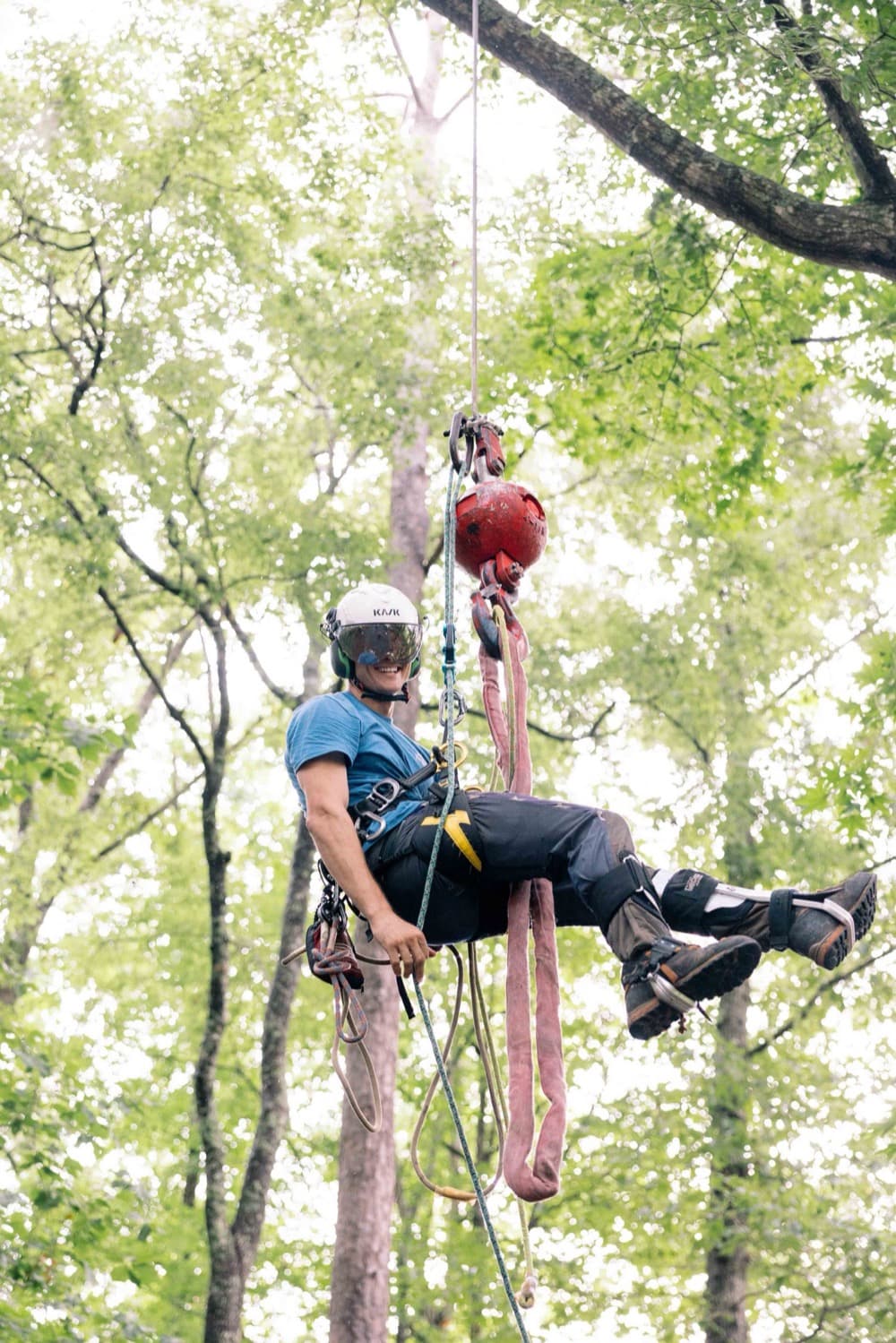
Tree Cabling and Bracing in Tallahassee
A weak branch union does not always mean the whole tree must come down. In some cases, cables or braces can reduce movement and help preserve it.
The first step is an inspection. Our arborists assess the defect, the tree's condition, and what could be hit if a limb fails. We explain whether support is a reasonable option and what monitoring it will need.
Miller's Tree Service installs cabling, bracing, and lightning protection systems in Tallahassee. A support system needs ongoing inspection; it does not remove every risk.
When You Need Structural Support
- Co-dominant stems with included bark forming a visible seam or crack at the union, which indicates a weak attachment likely to fail under wind load
- Heavy lateral limbs extending well beyond the canopy center, creating unbalanced weight distribution that stresses attachment points during storms
- Previous storm damage such as partial splits, hanging limbs, or cracks that have been repaired but left the structure compromised
- Heritage or specimen trees with irreplaceable character that justify investment in long-term preservation rather than removal
- Trees near structures, driveways, or gathering areas where failure would cause property damage or endanger people
- Lightning-prone trees that are the tallest specimens on a property or sit on elevated ground, especially longleaf pines and tall oaks
What's Included in a Structural Support System
Every cabling and bracing job is engineered to the individual tree. The service includes:
- A structural risk assessment by an ISA Certified Arborist
- A support system designed to the tree: cables, brace rods, or a combination
- Lightning protection with a copper conductor system where the tree warrants it
- Commercial-grade hardware rated for the actual loads involved
- Installation to ANSI A300 standards by trained climbers
- Correct cable placement and tensioning: typically two-thirds of the way from the weak point to the branch tips
- Scheduled follow-up inspection of tension, hardware, and new growth
- Proof of insurance: general liability and workers' compensation, available on request
Our Support System Process
-
Structural risk assessment. Our arborist conducts a thorough evaluation of the tree's architecture, examining branch attachment angles, the presence of included bark, cracks, cavities, decay indicators, lean, root plate stability, and overall crown symmetry. We identify each point of concern and rate the level of risk.
-
System design. Based on the assessment, we design a support configuration tailored to the tree. This may include supplemental cables to limit the spread between co-dominant leaders, brace rods to reinforce weak unions, or a combination of both. For trees at high lightning risk, we incorporate a copper conductor system routed from the crown to a buried ground rod.
-
Professional installation. Our trained climbers install all hardware following ANSI A300 standards for tree support systems. Cables are positioned at the correct height in the canopy (typically two-thirds of the distance from the weak point to the branch tips) and tensioned appropriately. Brace rods are drilled and bolted through the union to provide rigid reinforcement. All hardware is commercial grade and rated for the loads involved.
-
Periodic inspection and maintenance. Support systems require regular inspection as the tree continues to grow. We schedule follow-up visits to check cable tension, inspect hardware for wear or corrosion, and verify that the tree has not developed new structural issues that require additional support.
What Structural Support Costs in Tallahassee
Cabling and bracing is priced by the tree: its size, how many attachment points the structure needs, the hardware involved, and whether lightning protection is included. A single support cable on a moderately sized tree is an affordable, modest job. A multi-cable-and-brace system on a large heritage live oak is a bigger one. Either way, it is far less expensive than removing and replacing a tree that took a century to grow — or repairing what a failed limb lands on. We provide a free on-site assessment and a detailed written estimate.
The ISA Framework for Tree Support Systems
Tree cabling, bracing, guying, and propping all involve installing hardware in a living tree. Done right, that hardware buys decades of life for a tree worth keeping. Done wrong — or installed in a tree that shouldn't have hardware at all — it accelerates the failure it was meant to prevent. The framework below comes from the ISA Certified Arborist Study Guide and ISA's Best Management Practices: Tree Support Systems, which is what every Miller's installation is judged against.
Pruning Is Usually the First Move, Not Cabling
A real ISA-trained arborist considers pruning before installing support hardware. For small and medium trees, weak codominant stems and overextended branches can often be reduced or removed entirely — eliminating the load that would have required a cable in the first place. For larger trees, reducing outer branches lowers the load on whatever support is installed.
The honest cabling conversation always starts with: can we solve this with pruning instead? If yes, we do that. Cabling and bracing are for the trees that pruning alone can't make safe.
When Support Hardware Is Genuinely Warranted
ISA criteria for considering structural support:
- Codominant stems with included bark: two trunks of roughly equal diameter forking from a common point with bark embedded in the union. The classic split-down-the-middle defect.
- Split, defective, or decayed branch unions with an elevated likelihood of failure
- Overextended lateral branches carrying weight that exceeds the union's structural capacity
- Cracks: particularly longitudinal cracks at a branch union, where bracing rods can close the crack and limit further propagation
And — important — what the ISA framework says disqualifies a tree from support: if the root system is compromised, or if a significant amount of decay is present in the structural wood, removal is preferable to a support system. Hardware can't stabilize a tree whose foundation is failing.
Steel Cable Systems
Steel cable is the long-running standard. Two grades are common:
- 7-strand, common-grade cable: relatively malleable, easy to work with, widely used on residential trees
- Extra-high-strength (EHS) cable: much stronger but less flexible
Steel cables are known to last for many decades in trees without significant strength degradation. The installation requires drilling through the branches to anchor eye bolts or threaded rods — the wound is real, but the alternative (a no-hardware tree failing in a hurricane) is worse.
Per ANSI A300 (Part 3) standards, cables are placed about two-thirds the distance from the defect upward toward the branch tips. That position gives the cable the leverage to limit movement at the weak union without restricting healthy upper-canopy flex.
Brace Rods
Brace rods are threaded steel rods drilled through a defective union and bolted on either side. Used where a cable alone isn't enough — typically at a split codominant union where the rod compresses the crack closed and provides rigid reinforcement. Often installed in combination with a cable system above.
Lightning Protection: A Different System Entirely
Lightning protection is separate from cabling and bracing. It exists to give a lightning strike an alternate path of lower resistance to ground — protecting the tree from the catastrophic damage a direct strike causes.
A tree lightning protection system consists of three parts per ISA's Best Management Practices:
- Air terminal: the blunt copper tip mounted at the highest point of the tree
- Conductor: a heavy copper cable running from the air terminal down through the canopy and trunk
- Ground terminal: copper grounding rod(s) buried in the soil and connected to the conductor
Tallahassee's high lightning incidence makes specimen trees worth protecting: large heritage live oaks, tall pines near houses, isolated trees in open areas. The ISA framework lists candidates as the tallest tree in a group, trees in the open, trees near houses that are taller than the building, trees on hilltops, and trees of historic or economic significance.
One important note: lightning protection systems protect the tree, not the people under it. A protected tree is not a safe haven from lightning during a storm.
Inspection Is Not Optional
Per ISA standards, support systems and lightning protection systems both require periodic inspection — annually on fast-growing trees, every two to three years on slower-growing ones. Cables can stretch. Hardware corrodes. Trees grow and engulf fasteners. Lightning conductors can lose continuity at splices. An inspection schedule is part of every Miller's installation; we don't install hardware and walk away.
Why Tallahassee Properties Need Structural Support
Tallahassee sits squarely in the path of tropical storms and hurricanes that move through the Gulf of Mexico and across the Florida panhandle. Even storms that make landfall well to the east or west can produce sustained winds and gusts strong enough to split co-dominant trunks, tear overextended limbs from their attachments, and topple trees with compromised root systems. The city also experiences severe thunderstorms with damaging straight-line winds from late spring through early fall, and these localized events cause the majority of tree failures in the area on a year-to-year basis.
Given this wind exposure, the structural integrity of large trees is not merely an aesthetic concern but a genuine safety issue. A single limb from a mature live oak can weigh several thousand pounds and cause catastrophic damage to roofs, vehicles, fences, and utility lines when it falls. Proactive structural support is far less expensive than emergency removal, property repairs, and the loss of a tree that may have taken a century to grow.
What Tallahassee Homeowners Say
Real reviews from recent Miller's customers:
"This job was particularly difficult and required special equipment. The trees were in spaces that were tricky to access, and they did a fabulous job. They've been our tree surgeons for decades."
— Patty S.
"Ryan was very knowledgeable about the trees and what the best option was. He followed up before and after the job to make sure I was happy. The service and knowledge made the difference."
— Jay F.
"These guys are professional and team players at their best. The crew worked like a well-oiled machine — each one knew exactly what to do."
— Mary S.
Frequently Asked Questions
How much does tree cabling and bracing cost in Tallahassee?
Costs depend on the size of the tree, the number of attachment points, the type of hardware required, and whether lightning protection is included. A single cable installation on a moderately sized tree is quite affordable, while a comprehensive multi-cable and brace rod system on a large live oak costs more. We provide free on-site assessments and detailed estimates.
What's the difference between cabling and bracing?
Cables are flexible and installed high in the canopy to limit how far weak or co-dominant stems can move apart under wind load. Brace rods are rigid — drilled and bolted directly through a weak union to hold it together. Many trees benefit from both: braces stabilize the union, cables reduce the forces reaching it.
Will cabling damage my tree?
Modern support hardware is designed to minimize impact on the tree. Cables attach to through-bolts or lag hooks that the tree compartmentalizes and grows around over time. When installed correctly, the hardware does not weaken the tree and the small wounds at the attachment points heal normally.
Can a cabled tree still fail?
A support system reduces the probability of failure — it does not eliminate it. Cabling buys margin against the loads a structure would otherwise not survive, and for most defects that margin is the difference. But no system makes a tree storm-proof, which is why we pair support with honest assessment and periodic inspection.
Is it better to cable a weak tree or remove it?
It depends on the severity of the defect and the value of the tree. A minor structural flaw in a treasured heritage oak is a strong candidate for cabling. A severely decayed tree, or one where failure would be catastrophic, is often better removed. Our arborist gives you an honest read either way.
How long do support systems last?
High-quality cable and brace rod systems typically remain effective for many years, but they are not permanent. Components can stretch, corrode, or become engulfed by tree growth, which is why periodic inspection is essential. We generally recommend inspection every two to three years and replacement of any worn components.
Do you install lightning protection for trees?
Yes. For tall, isolated, or historically significant trees at elevated lightning risk, we install a copper conductor system routed from the upper crown to a buried ground rod, which carries a strike safely to ground instead of through the trunk.
Areas We Serve
Miller's Tree Service provides structural support system installation throughout Tallahassee, Leon County, and the surrounding North Florida and South Georgia region including Wakulla County, Gadsden County, Jefferson County, Thomasville, and Crawfordville.
A support system starts with an honest assessment — see our tree hazard inspection service, or read more on tree support systems and why you might need them.
Contact us today at (850) 894-TREE for a free estimate.


