Insect and Disease Control in Tallahassee
Half a canopy has lost its leaves. There are holes in the bark. A patch of fungus has appeared at the base. Each is a reason to look closer, but none tells the whole story.
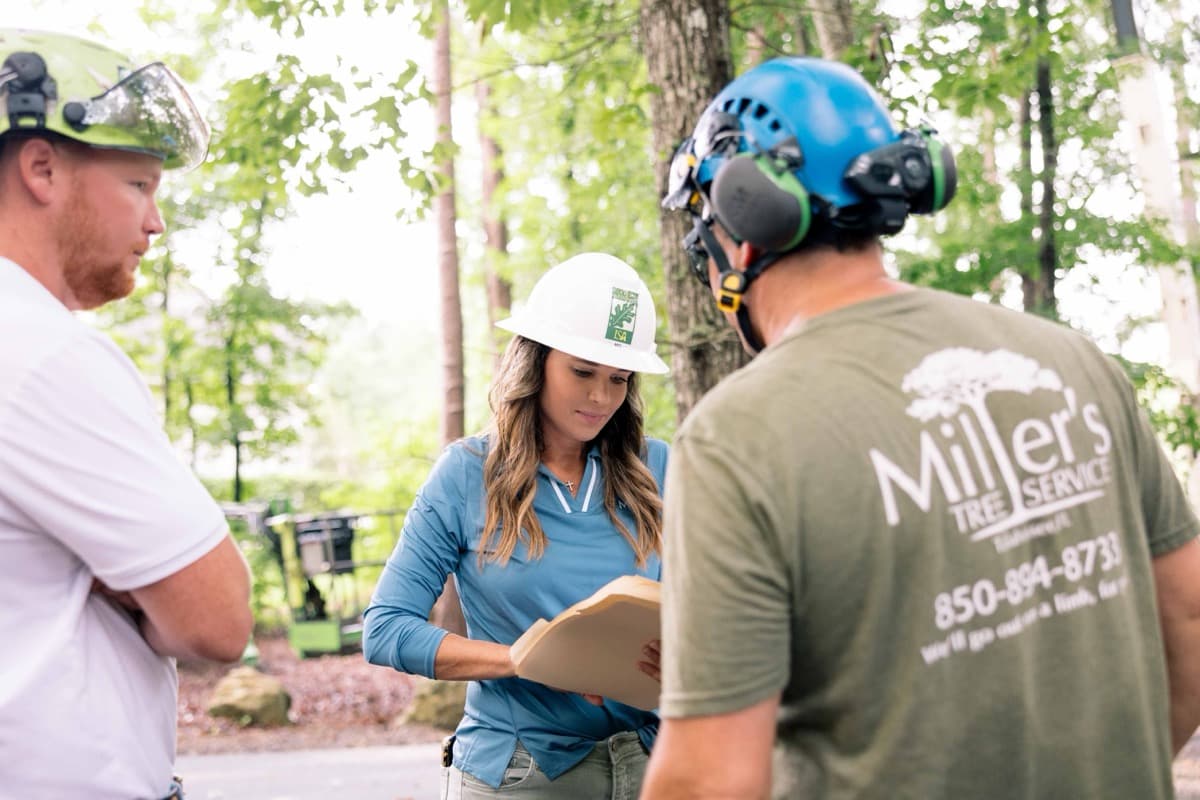
Our arborists inspect the tree and its growing conditions to identify the cause. A pest infestation, disease, and root stress can produce similar symptoms. The diagnosis determines whether treatment can help.
Miller's Tree Service treats tree pests and diseases across Tallahassee. If you are unsure what you are seeing, start with a free tree disease assessment. We will explain what we find and your options.
Common Pests and Diseases in Tallahassee
- Laurel wilt: A devastating fungal disease spread by ambrosia beetles that has killed large numbers of redbay trees and threatens other members of the laurel family across North Florida
- Oak wilt: A vascular disease caused by the fungus Ceratocystis fagacearum that can kill red oaks rapidly and also affects live oaks, spreading through root grafts between neighboring trees
- Scale insects: Armored and soft scale species feed on sap from branches and leaves of magnolias, crape myrtles, and hollies, producing honeydew that leads to sooty mold buildup
- Pine bark beetles: Southern pine beetles and Ips engravers attack stressed longleaf, loblolly, and slash pines, boring beneath the bark and introducing blue-stain fungi that block water transport
- Hypoxylon canker: A stress-related fungal disease that colonizes the sapwood of oaks weakened by drought, root damage, or construction activity
- Cercospora leaf spot and powdery mildew: Common foliar diseases that cause premature leaf drop in crape myrtles, dogwoods, and other ornamental species during Tallahassee's humid summers
What's Included in Every Insect & Disease Service
The wrong treatment applied confidently is worse than no treatment. Every insect and disease service includes:
- An on-site evaluation by an ISA Certified Arborist
- Accurate identification of the specific pest or pathogen — with lab analysis when symptoms overlap
- A treatment plan matched to the diagnosis: trunk injection, soil-applied systemic, foliar spray, or sanitation pruning
- Application timed to the organism's life cycle, when it is actually effective
- A follow-up inspection to confirm the treatment worked
- Optional seasonal monitoring for high-risk or high-value trees
- Clear guidance on any precautions to take after an application
- A free evaluation and written estimate before any work begins
Our Diagnostic and Treatment Process
-
On-site evaluation. An arborist visits your property to examine affected trees, looking at leaf symptoms, bark condition, canopy density, the presence of boring dust or exit holes, fungal fruiting bodies, and overall vigor. We also assess site conditions such as drainage, soil compaction, and recent construction that may be contributing to the problem.
-
Identification and diagnosis. Based on visible symptoms and, when needed, laboratory sample analysis, we pinpoint the specific pest or pathogen responsible. Accurate identification is essential because treatments vary widely between organisms that can produce similar-looking symptoms.
-
Customized treatment plan. We develop a treatment strategy matched to the diagnosis. Options include trunk-injected systemic insecticides or fungicides, soil-applied treatments absorbed through the root system, foliar sprays for active infestations, and sanitation pruning to remove infected tissue and slow disease spread.
-
Application and follow-up. Treatments are applied at the timing most effective for the target organism's life cycle. We schedule follow-up inspections to evaluate treatment success and make adjustments if needed.
-
Preventive monitoring program. For properties with recurring pest pressure or high-value trees at elevated risk, we set up a seasonal monitoring and preventive treatment schedule that addresses threats proactively rather than reactively.
The ISA Diagnostic Process: Why 70-90% of "Tree Diseases" Aren't Diseases
Here's the number that surprises homeowners most: per the ISA Certified Arborist Study Guide, approximately 70 to 90 percent of all plant problems result from adverse cultural and abiotic environmental conditions — soil compaction, drought, moisture extremes, temperature stress, mechanical injury, or poor species selection. Insects, mites, and pathogens are the cause in a small minority of cases. Most of the time, when an insect or pathogen is present on a declining tree, it's an opportunist exploiting a tree already weakened by something else.
This is why a real diagnostic visit starts with the site and the soil, not the visible symptom. The framework below comes directly from the ISA Study Guide, and it's the process every Miller's diagnostic visit follows.
Biotic vs. Abiotic — and Why It Matters
The first split:
- Biotic agents are living organisms causing the problem — fungi, bacteria, viruses, insects, mites, mammals. They tend to spread from plant to plant and usually produce nonuniform damage patterns.
- Abiotic agents are nonliving causes — drought, flooding, soil compaction, lightning, herbicide drift, deicing salt, mechanical injury, nutrient deficiency, temperature extremes. They tend to produce uniform damage patterns across an area or across multiple species.
That distinction is the first diagnostic lever. If multiple unrelated species in the same area are showing similar damage, the cause is almost certainly abiotic. If one tree in a row of identical neighbors is the only one declining, biotic agents move higher on the list.
The ISA Six-Step Diagnostic Process
The systematic approach the ISA framework prescribes:
1. Accurately identify the plant. Many insects and diseases are host-specific. A symptom on an oak and the same symptom on a pine often have completely different causes. Knowing the species, hybrid, or cultivar narrows the suspect list dramatically. (See our Tallahassee tree ID guide for the common species we see locally.)
2. Look for a pattern of abnormality. Compare the affected tree to others on the site, especially of the same species. Nonuniform damage patterns within a tree or among individual trees usually indicate biotic factors. Uniform damage across many trees or species points to abiotic causes.
3. Carefully examine the site. Light levels, soil characteristics, water availability, prevailing winds, contour of the land, structures present, recent construction, deicing salt or herbicide exposure, microclimate. A driveway extension three years ago changes the diagnostic picture for any tree within its drip line.
4. Note color, size, and thickness of foliage. Chlorosis (yellowing), necrosis (dead tissue), leaf scorch, defoliation, undersized leaves, twisted or curled foliage, early autumn color, premature leaf drop. Many disorders first apparent in the foliage actually originate in the roots or vascular system — the leaves are the visible end of an underground problem.
5. Check trunk and branches. Bark discoloration, oozing, loose bark, cankers, wounds, dead sections, watersprout proliferation, exit holes from borers, frass (insect waste — a definite sign, like ambrosia beetle "toothpicks"), fungal fruiting bodies. Assessing year-over-year terminal growth by measuring between bud scale scars often shows when decline began.
6. Examine the roots and root collar. The ISA Study Guide calls this "the most frequently overlooked portion of the tree in the diagnostic process" — and the most consequential. Healthy fine roots are light-colored inside, flexible, and firm. Brown roots indicate drought or chemical toxicity. Black roots with a sour smell and bluish-gray soil indicate saturation and root rot. Buried root flare, girdling roots, severed buttress roots from construction — all root-zone problems show up in the canopy years before homeowners connect them.
The "Decline Disease" Concept
Many of the worst tree decline cases we see in Tallahassee fit what the ISA framework calls a decline disease — the gradual deterioration of a tree from multiple interacting and interchangeable factors:
- Predisposing factors (chronic) — old age, poor site, compacted soil, prior construction damage
- Inciting factors (acute trigger) — drought year, defoliation event, lightning strike, severe pruning
- Contributing factors (opportunists) — bark beetles, canker fungi, root rot pathogens that exploit the weakened tree
This is why the diagnostic conclusion can't just be "the tree has bark beetle." Bark beetle is the contributing factor. The real questions are: what predisposed this tree? and what inciting event tipped it over? Treating only the beetle, without addressing the underlying stress, almost always fails.
Signs vs. Symptoms
One more piece of diagnostic vocabulary the ISA Study Guide stresses:
- A symptom is the tree's response to a problem — chlorosis, wilting, dieback, leaf spot
- A sign is direct evidence of the causal agent itself — fungal fruiting body, insect frass, the insect itself, mycelium under the bark
Diagnoses are stronger when supported by signs, not just symptoms. Many tree problems produce similar symptoms; the signs are what separate them.
This is the framework. The diagnosis isn't a guess and the treatment isn't reflexive. We don't sell fungicide to a tree whose problem is soil compaction — and we don't sell removal to a tree whose problem is fixable.
What Insect and Disease Treatment Costs in Tallahassee
What treatment costs depends on three things: the organism, the method it calls for, and the number and size of the trees involved. A single trunk injection for one tree is modest. Managing an active outbreak across a property of mature trees costs more. The math that matters, though, is the one in the section below — early treatment is routinely a fraction of the removal it prevents. Every diagnosis starts with a free on-site evaluation and a written estimate, and our free tree disease assessment costs nothing at all.
Why Tallahassee Trees Face Elevated Risk
Most tree diseases are opportunists. They don't attack healthy trees — they attack trees that are already compromised. A live oak with a root zone that was compacted during a driveway renovation five years ago. A pine that went through a drought summer without supplemental water. A magnolia planted too close to a foundation and slowly girdled by its own roots.
In Tallahassee, the underlying stressors are everywhere. Construction in established neighborhoods disturbs root systems without any visible above-ground sign. Sandy soils drain fast and leave trees dry between rains. The long growing season means insects get seven or eight generations per year to build populations instead of three or four.
The result is that Tallahassee trees face threats that compound quietly for years before anything dramatic happens. Regular monitoring and early treatment are the difference between a $300 trunk injection and a $3,000 removal. We've seen both outcomes on the same block, on the same species, in the same year — the only difference being whether someone called early enough.
What Tallahassee Homeowners Say
Real reviews from Miller's customers across Tallahassee:
"My scope of work was to prune overgrowth around our remaining dogwoods and apply fungicide in hopes of keeping them alive from the blight that's killing them all over the south. Miller's certified arborist, Tim, was very knowledgeable, patient, and thorough. I highly recommend Miller's Tree Service."
— Allen P.
"They removed a very dead tree which was extremely difficult to access. They were knowledgeable, skillful, and the crew was very kind and tidy. They left my yard clean and safe."
— Taylor A.
"They were very professional and cleaned up everything. I would highly recommend Miller's Tree Service."
— Nancy G.
Frequently Asked Questions
How much does insect and disease treatment cost in Tallahassee?
Treatment costs vary based on the type of pest or disease, the size and number of trees affected, and the treatment method required. Trunk injections for a single tree may be quite affordable, while managing a multi-tree outbreak across a property costs more. We provide free evaluations and detailed estimates before any work begins.
How can I tell if my tree has a disease or insect problem?
Watch for changes in leaf color or size, premature leaf drop, thinning of the canopy, sawdust-like material on the bark, small holes in the trunk, oozing sap, mushrooms growing at the base, and branches dying back from the tips. Any of these signs warrant a professional assessment.
What are the most serious tree diseases in Tallahassee?
The threats we treat most often are laurel wilt (fatal to redbays, spread by ambrosia beetles), oak wilt and Hypoxylon canker in stressed oaks, pine bark beetles in drought-stressed pines, and scale insects on ornamentals. Several are manageable if caught early; a few, like laurel wilt, are not — which is exactly why prompt, accurate diagnosis matters.
Can you save a tree that already has a disease?
It depends entirely on the organism and how early it's caught. Many fungal and insect problems can be stopped or slowed with targeted treatment. Others are not curable — and in those cases the honest answer is removal before the tree fails. We diagnose first and tell you the real prognosis either way.
Can you prevent pests and diseases before they start?
Yes. For high-value trees or trees already at elevated risk, we set up a seasonal preventive program — monitoring plus treatments timed to pest life cycles. Keeping trees healthy and well-fed through proper tree care and fertilization is itself the best prevention, since pathogens overwhelmingly target already-stressed trees.
Are the treatments safe for pets and children?
We prioritize low-impact treatment methods and apply products according to label requirements. Trunk injection and soil-applied systemic treatments are contained within the tree or root zone, minimizing exposure. We will always inform you of any precautions to take following an application.
What is the free tree disease assessment?
If a tree looks off and you're not sure why, our free tree disease assessment brings an arborist to your property to evaluate it at no cost — the easiest way to catch a treatable problem before it becomes a removal.
Areas We Serve
Miller's Tree Service provides insect and disease control throughout Tallahassee, Leon County, and the surrounding North Florida and South Georgia region including Wakulla County, Gadsden County, Jefferson County, Thomasville, and Crawfordville.
Want to know what you're up against? Our guide to the top tree diseases of North Florida covers what every Tallahassee homeowner should watch for.
Contact us today at (850) 894-TREE for a free estimate.


