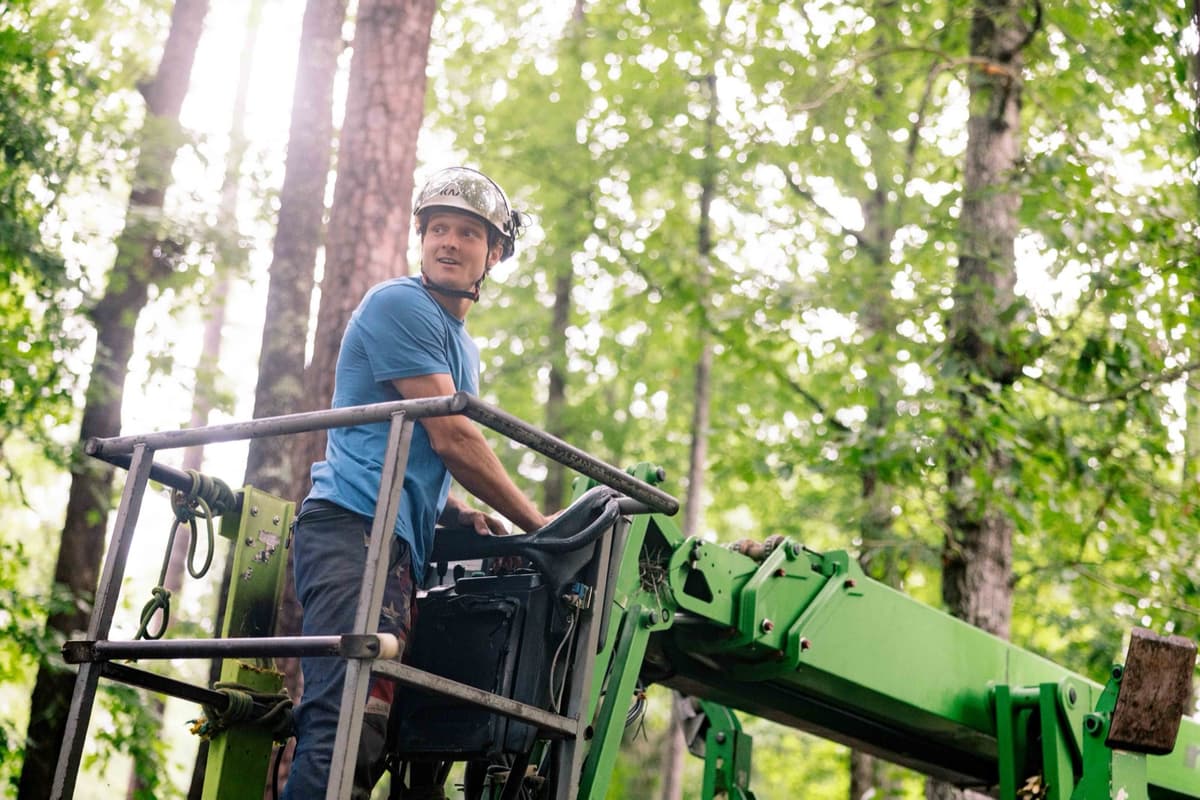
Tree Hazard Inspections in Tallahassee
Green leaves tell you a tree is alive. They do not tell you whether its trunk, roots, or branch unions can support it.
A tree risk assessment looks at the whole tree and what it could hit if it failed. Our TRAQ-qualified arborists inspect its condition, identify defects, and explain which concerns need attention. When a visual inspection leaves questions, we may recommend further investigation.
Miller's Tree Service provides documented tree risk assessments in Tallahassee. You receive findings and recommendations you can use to decide what to prune, support, remove, or monitor.
When You Need a Tree Hazard Inspection
- You notice visible signs of decline such as dead branches, crown dieback, bark separation, leaning, or fungal fruiting bodies at the base of a tree
- A significant weather event has recently occurred and you want to assess whether your trees sustained hidden damage
- Construction, excavation, or grading work has taken place near the root zone of mature trees on your property
- You are purchasing a property and want a professional assessment of the trees before closing
- Your insurance company or municipality requires a documented tree risk evaluation
- Large, mature trees overhang your home, driveway, patio, or play areas and you want peace of mind about their condition
What's Included in a Tree Hazard Inspection
A Miller's hazard inspection is a systematic, documented assessment — not a quick glance and a verbal opinion. Every formal inspection includes:
- A ground-to-crown evaluation by an ISA Certified, TRAQ-qualified arborist
- Assessment of the root flare, trunk, scaffold limbs, branch unions, and canopy for cracks, cavities, included bark, decay, and root compromise
- Advanced diagnostics when warranted: resistograph drilling or sonic tomography to map internal decay without harming the tree
- A risk rating for each tree following the ISA Tree Risk Assessment framework
- A clear written report with photographs documenting every condition of concern
- Specific mitigation recommendations: pruning, cabling and bracing, monitoring, or removal
- An in-person review of the findings, explained in plain language
- Documentation suitable for insurance, municipal, or legal use
Our Inspection Process
-
Detailed visual assessment. Our arborist systematically examines each tree from the ground up, evaluating the root flare, trunk, major scaffold limbs, branch unions, and overall canopy condition. We check for cracks, cavities, included bark, dead branches, fungal indicators, soil heaving, and signs of root compromise.
-
Advanced diagnostics when warranted. If the visual inspection reveals conditions that need further investigation, we may use a resistograph to measure wood density along a drill path or sonic tomography to create a cross-sectional map of internal decay. These tools give us objective data about how much sound wood remains in a compromised trunk or limb.
-
Risk rating and written report. All findings are compiled into a clear written report that includes a risk rating for each inspected tree, photographs documenting conditions of concern, and specific recommendations for mitigation. Risk levels follow the ISA Tree Risk Assessment framework, giving you a standardized and defensible evaluation.
-
Mitigation consultation. We review the report with you in person, explain the findings in plain language, and discuss your options. Depending on the situation, mitigation may involve targeted pruning, cable and brace installation, monitoring on a schedule, or removal of trees that cannot be made safe.
The ISA Risk Assessment Framework: What We Actually Evaluate
A real tree risk assessment isn't a vibe check. It's a structured evaluation that follows the same methodology our ISA-credentialed arborists are tested against — the framework laid out in the ISA Certified Arborist Study Guide and ISA's TRAQ (Tree Risk Assessment Qualification) program. The pieces below are what we're actually looking at when we walk your property.
Risk = Likelihood × Consequences
Tree risk is the combination of two things: how likely a failure is, and how bad it would be if it happened. The ISA framework treats them as independent factors that get combined into a final risk rating:
- Likelihood of failure: how likely is this tree (or specific part) to fail within a stated time frame (usually 1–3 years)
- Likelihood of impact: if it fails, how likely is it to hit a target that matters (a person, a structure, a vehicle)
- Consequences of failure: if it does hit the target, how bad is the outcome (negligible, minor, significant, severe)
Combining likelihood-of-failure × likelihood-of-impact gives an impact rating (unlikely → very likely). Crossed against consequences, that yields the final risk category: Low / Moderate / High / Extreme. Two trees can have identical defects and very different risk ratings depending on what's underneath them.
The Three Levels of Assessment
ISA recognizes three levels — and the right level depends on the assignment.
- Level 1 — Limited Visual Assessment. A drive-by or walk-by inspection that screens a population of trees quickly for obvious defects: dead trees, large cavities, severe leans, hanging limbs. Used when you need to triage many trees fast.
- Level 2 — Basic Assessment. A detailed visual inspection from all sides of one tree — root flare, buttress roots, trunk, branches, surrounding site. May involve simple tools (mallet for sounding, probe, binoculars). This is what most homeowners need.
- Level 3 — Advanced Assessment. Specialized techniques on specific concerns: resistograph drilling, sonic tomography, root collar excavation, aerial inspection by climber or lift, load testing. Used when a Level 2 reveals something that needs internal investigation.
When we quote a tree assessment, we tell you which level it is. A Level 3 takes longer and costs more — but only when it's warranted.
What We Look For: The Major Defect Categories
The ISA framework identifies seven major defect/condition categories that increase failure likelihood. Every Miller's inspection walks through these systematically:
- Dead, dying, or hanging parts. Dead branches in the canopy, branches partially detached and lodged ("hangers"), entirely dead trees.
- Cracks. Longitudinal cracks (along the trunk's length) versus transverse cracks (across the short axis). Transverse cracks often mean failure is imminent.
- Weakly attached branches and codominant stems with included bark. Two trunks of nearly equal diameter with bark embedded inside the union — the classic split-down-the-middle failure point on water oaks.
- Unusual architecture. Severe lean, unbalanced canopy, lack of trunk taper, long unattached lateral branches.
- Loss of root support. Recent lean increase, soil heaving on one side, depressed soil on the lean side, severed or buried buttress roots from recent construction.
- Decay and missing wood. Cavities, fruiting bodies (conks, mushrooms) on the trunk or root flare, soft or crumbly wood under bark, carpenter ant nesting (carpenter ants only nest in decayed wood — they're a definite indicator).
- Mechanical damage and cankers. Old pruning wounds that didn't close, lightning scars, weed-trimmer damage at the base, bark canker infections.
Each defect is rated on severity and combined with the others. A tree with one moderate defect may be low risk; the same tree with three combined defects in the same trunk often isn't.
Decay Type Matters
Not all wood decay is the same. The ISA Study Guide identifies three fungal decay types, and they behave differently:
- White rot (e.g., Armillaria, Ganoderma) — primarily decays lignin (the compound that gives wood its compressive strength). Reduces stiffness but leaves some flexibility. Trees often adapt with response growth.
- Brown rot (e.g., Laetiporus, Phaeolus) — primarily decays cellulose, leaving stiff but brittle lignin. Wood becomes dry and crumbly, more prone to brittle fracture. Faster strength loss than white rot.
- Soft rot (e.g., Kretzschmaria deusta) — similar to brown rot but with characteristics of both. A serious finding in living trees.
In Tallahassee, Ganoderma at the root flare on live oaks is the diagnosis we make most often that has the most consequences — it's a root rot with no effective treatment in advanced stages, and it leads to whole-tree uprooting failure under storm load.
Response Growth: What Makes a Tree Stable Despite Defects
Trees adapt. When a defect develops, the tree often produces response growth — denser, sometimes chemically different wood that compensates for the weakness. We look for:
- Bulges and enlarged areas around cracks, cavities, or decay zones (compensating for lost strength)
- Woundwood ridges ("ram's horns") at the edges of old wounds
- Trunk taper and buttress root development indicating the tree has been loaded and responded
- Flexure wood at the base from years of wind-loading
A tree with a 30% basal cavity and extensive compensating response growth is a very different risk profile than the same tree with no compensation. This is the kind of judgment a 30-second visual estimate can't make.
Mitigation Options (Not Just "Cut It Down")
ISA mitigation falls into a hierarchy — we work from least invasive to most:
- Target management — fence off the tree, reroute pedestrian or vehicle traffic, relocate the kids' swing set. Cheapest. Lowest impact on the tree.
- Pruning — selective removal of dead, dying, or weakly attached branches; reduction pruning to lower wind sail. Per ISA standards, never topping.
- Structural support — cables, braces, or lightning protection systems for trees with specific defects worth retaining.
- Removal — the right answer when no other mitigation works, but the last resort, not the first.
A Miller's report names the specific mitigation we recommend and why — and where there are multiple acceptable options, we explain the trade-offs so you can make the call.
What a Tree Hazard Inspection Costs in Tallahassee
There are really two levels of tree assessment, and they're priced differently.
A visual hazard check as part of a free estimate costs nothing. Any time a Miller's arborist is on your property to quote work, they are reading the trees around them — and if something looks wrong, they will tell you.
A formal written TRAQ risk assessment — the documented, defensible kind used for an insurance claim, a municipal permit, a real estate transaction, or a property-line dispute — is a professional service priced by scope: how many trees are evaluated, and whether advanced diagnostics like resistograph drilling or sonic tomography are needed. A single-tree report is quite affordable; a full-property evaluation is quoted by tree count. Call us for a free phone consultation and we'll tell you which level you actually need and what the report will run.
Why Tallahassee Properties Need Hazard Inspections
Tallahassee's mature urban canopy includes many trees that are 60, 80, or over 100 years old. While these large specimens are tremendously valuable for shade, beauty, and property value, they also carry greater risk simply due to their age and size. The longer a tree has been growing in one spot, the more time decay organisms, root disturbance, and structural stress have had to accumulate.
Several species common across Leon County are particularly prone to hidden hazards. Water oaks frequently develop internal decay that can hollow out a trunk while the exterior bark still looks intact. Live oaks may develop ganoderma root rot, a fungal infection that destroys the root plate and can lead to whole-tree failure during storms. Even healthy-looking pines can harbor bark beetle infestations that weaken them from within. Tallahassee's sandy soils also provide less anchorage than heavier soil types, making root stability a critical factor in any risk assessment. Regular hazard inspections catch these problems early, giving you time to address them before they become emergencies.
What Tallahassee Homeowners Say
Real reviews from recent Miller's customers:
"Ryan was very knowledgeable about the trees and what the best option was. He followed up before and after the job to make sure I was happy. The service and knowledge made the difference."
— Jay F.
"Miller's certified arborist, Tim, was very knowledgeable, patient, and thorough in explaining what they would do and what to expect. I highly recommend Miller's Tree Service."
— Allen P.
"They've been our tree surgeons for decades. This job was particularly difficult — 5 trees were dead near power lines in spaces that were tricky to access. They did a fabulous job."
— Patty S.
Frequently Asked Questions
How much does a tree hazard inspection cost in Tallahassee?
A visual hazard check during a free estimate costs nothing. A formal written TRAQ risk assessment — the documented kind used for insurance, permits, or legal purposes — is priced by scope: the number of trees and whether advanced decay-detection tools are needed. A single-tree report is quite affordable; multi-tree evaluations are quoted by tree count. Call us for a free phone consultation.
How often should I have my trees inspected?
For properties with large, mature trees near structures, we recommend a professional inspection every two to three years. You should also schedule an inspection after any significant storm, following nearby construction, or anytime you notice a change in a tree's appearance such as new lean, sudden branch dieback, or mushrooms growing at the base.
What is a TRAQ tree risk assessment?
TRAQ stands for Tree Risk Assessment Qualification, a credential from the International Society of Arboriculture. A TRAQ assessment follows a standardized method that rates three things for each tree: the likelihood it will fail, the likelihood that failure hits a target (your house, a car, a walkway), and the consequences if it does. The result is an objective, defensible risk rating — not a guess.
How do you detect decay inside a tree that looks healthy?
When a visual inspection raises concern, we use a resistograph — a fine drill that measures wood density along its path — or sonic tomography, which builds a cross-sectional map of the trunk from sound waves. Both reveal internal decay and quantify how much sound wood remains, without harming the tree.
What happens if a tree is found to be hazardous?
If our inspection identifies a hazardous condition, we provide specific recommendations based on the severity of the risk and the value of the tree. In some cases, targeted pruning or structural support can reduce risk to acceptable levels. In other cases, removal is the safest course. Our report gives you the information to make an informed decision, and we can perform any recommended work promptly.
Will a hazard inspection report satisfy my insurance company or the city?
Yes. Our written reports follow the ISA Tree Risk Assessment framework and are accepted by insurance adjusters and municipal reviewers. If your insurer or the City of Tallahassee has asked for a documented evaluation, a Miller's TRAQ report meets that requirement.
Can a certified arborist's report let me remove a protected tree?
Often, yes. Under Florida Statute 163.045, a homeowner may remove any tree that an ISA Certified Arborist documents as a danger to people or property — regardless of local permit requirements. If a hazard inspection finds that level of risk, our report can serve as that documentation. Our ISA Certified Arborists handle both the assessment and the paperwork.
Areas We Serve
Miller's Tree Service provides tree hazard inspections throughout Tallahassee, Leon County, and the surrounding North Florida and South Georgia region including Wakulla County, Gadsden County, Jefferson County, Thomasville, and Crawfordville.
Not sure whether a tree is worth worrying about? Our guide on how to spot a hazardous tree covers the warning signs homeowners can see from the ground.
Contact us today at (850) 894-TREE for a free consultation about your tree inspection needs.


