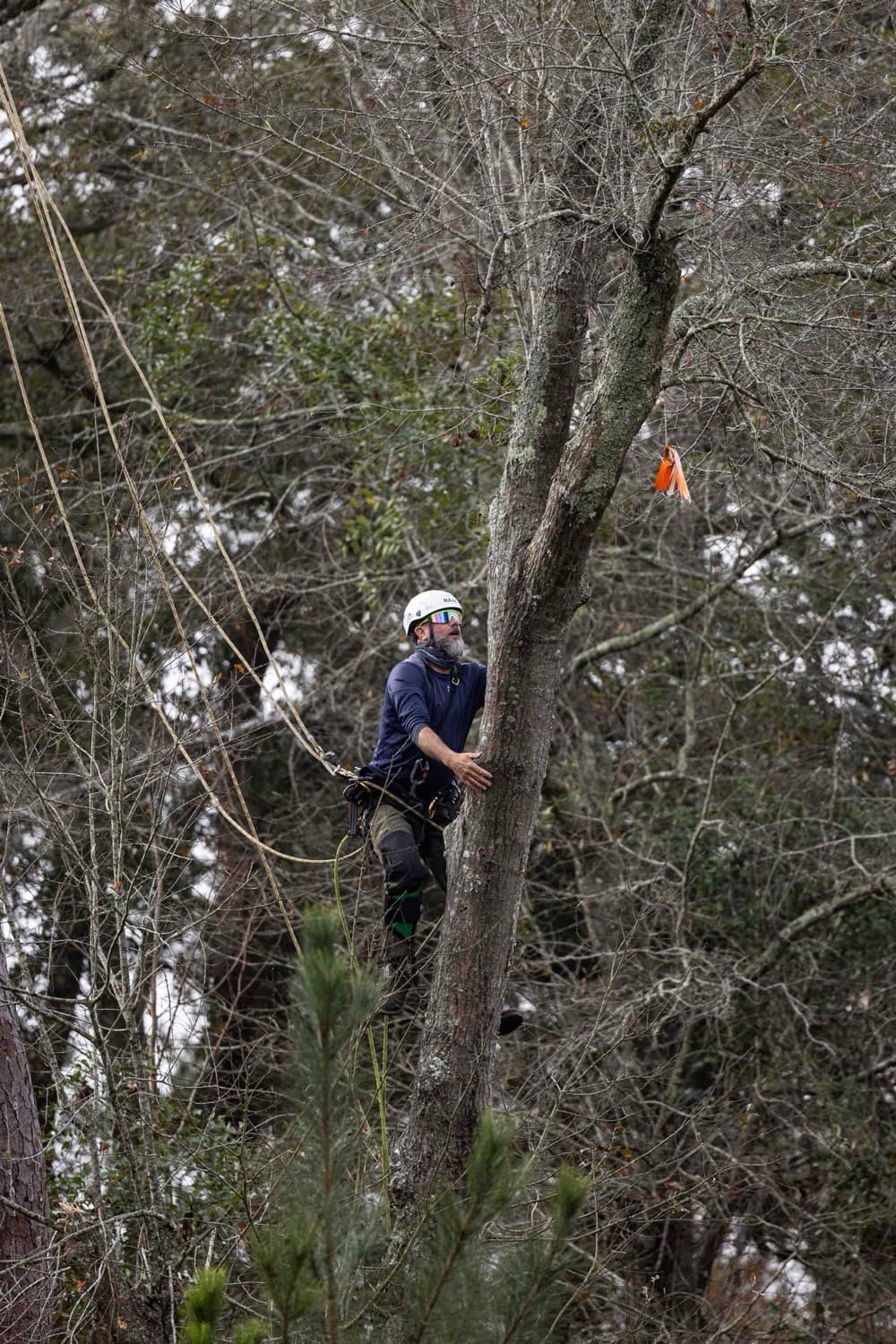
Tree Pruning in Tallahassee
Every cut should have a reason: remove a dead limb, improve a weak structure, or create clearance above a roof or walkway.
Our ISA Certified Arborists assess the tree's species, age, and condition before recommending pruning. We explain which branches need attention and what should stay. We follow ANSI A300 standards and do not top trees.
Miller's Tree Service prunes trees throughout Tallahassee, from young shade trees to mature oaks and pines. We plan the cuts and the cleanup before the work begins.
When You Need Tree Pruning
- Dead, broken, or diseased branches are visible in the canopy and could fall at any time
- Limbs are growing too close to your home, roof, gutters, or utility lines and need clearance
- The canopy has become overly dense, reducing airflow and creating excess wind resistance during storms
- Young trees need structural training to develop strong branch architecture early in their growth
- You want to improve sunlight penetration to your lawn, garden beds, or outdoor living spaces
- Storm season is approaching and you want to reduce the risk of limb failure during high winds
What's Included in Every Pruning Job
A Miller's pruning estimate spells out exactly which branches come off and why — not a vague "trim the tree." Every job includes:
- On-site assessment by an ISA Certified Arborist who sets the pruning objectives with you
- A written, itemized estimate with a clear scope of work
- ANSI A300-standard cuts: proper branch-collar cuts, never topping, flush cuts, or lion-tailing
- Trained climbing and aerial-lift crews for safe access to the full canopy
- The specified work: deadwood removal, crown thinning, crown raising for clearance, or structural training
- All brush chipped on site and debris hauled away
- Full cleanup: your yard left cleaner than we found it
- Proof of insurance: general liability and workers' compensation, available on request
Our Pruning Process
-
Arborist consultation. We start with a walkthrough of your property to assess each tree's condition, discuss your goals, and identify the specific pruning work needed. Common objectives include deadwood removal, crown thinning, crown raising for clearance, and structural correction.
-
Species-specific pruning plan. Different species respond differently to pruning. Live oaks, for example, benefit from selective thinning that preserves their broad spreading form, while longleaf pines require careful attention to maintain a single dominant leader. Our arborists design each pruning plan around the tree's biology and growth habits.
-
Precision cutting by trained crews. Our climbing and aerial lift crews make clean, properly placed cuts that promote rapid wound closure and minimize stress to the tree. We never leave stubs, flush cuts, or lion-tailed branches that invite decay and regrowth problems.
-
Complete cleanup. All brush is chipped on site and all debris is removed from your property. We leave your yard cleaner than we found it.
ISA Pruning Standards: What Proper Tree Pruning Actually Means
Most "tree trimming" performed in residential yards is, by ISA standards, not pruning at all. The difference is technical — and it matters. The principles below come straight from the ISA Certified Arborist Study Guide and ANSI A300 (Part 1) standards our arborists are credentialed against. They're the same principles every cut Miller's makes is judged by.
The seven pruning objectives we work to
Every pruning job we estimate has a written objective. ISA recognizes seven:
- Improving structure — selectively removing dead, weakly attached, or competing branches in young trees to establish a strong dominant leader and well-spaced scaffold branches
- Reducing risk — removing or reducing specific branches to lower the likelihood of failure on mature trees
- Providing clearance — directional pruning to keep branches away from structures, traffic, lines of sight, or utility lines
- Managing crown size — reduction cuts to lower height or spread when necessary
- Reducing crown density — selective interior thinning to allow wind and light penetration (replaces the older term "thinning")
- Restoring structure — corrective pruning on trees damaged by storms or previous topping
- Rejuvenating shrubs — large reduction cuts near ground level to revive declining shrubs
If a pruning quote doesn't tell you which of these objectives it's accomplishing — and which branches it covers — the work hasn't been planned.
The three types of pruning cuts
ISA recognizes three. Each one has a specific anatomy and a specific use.
Branch removal cut. Removes the smaller of two stems at a union — for example, a side branch from the trunk. The cut is made just outside the branch collar (the swollen ring of trunk tissue at the branch's base) and the branch bark ridge (the raised strip of bark on top of the union). This leaves the tree's natural defense system — the branch protection zone, a cone of denser, chemically defended wood inside the union — intact. Cutting flush to the trunk damages this zone and lets decay enter the stem.
Reduction cut. Removes the larger of two branches back to a live lateral that is at least one-third the diameter of the branch being removed. This is the cut used for size management and corrective pruning on mature trees. Reduction cuts larger than 10 cm (4 inches) in diameter are avoided where possible, because trees compartmentalize them less effectively than removal cuts.
Heading cut. Removes a stem to a bud or to a lateral smaller than one-third the diameter of the parent branch. Useful on shrubs and for crown restoration after storm damage — but not appropriate for routine work on mature trees, because the regrowth that follows is weakly attached and the wound rarely closes well.
The three-cut method for large branches
Branches too large to support by hand are removed in three cuts to prevent bark tear and damage to the branch protection zone:
- Undercut. Made on the underside of the branch, 15–30 cm (6–12 inches) out from the union. About a third of the way through.
- Top cut. Made from the top, slightly outside the undercut. The branch falls cleanly when this cut meets the undercut.
- Final cut. Removes the remaining stub just outside the branch bark ridge and branch collar — no flush cut, no stub.
Stubs invite decay; flush cuts invite worse. Both are how short-cycle pruning crews shorten trees' lives.
Why we never top a tree
Topping — cutting live branches back to stubs without regard to the branch protection zone — is the single most damaging thing done to trees in residential settings. The ISA cites six consequences:
- Starvation — the tree loses a large portion of its photosynthetic capacity at once
- Decay — large, terminally located cuts overwhelm the tree's chemical defenses
- Weak regrowth — the watersprouts that emerge are far more likely to fail than normal branches
- Rapid regrowth — the tree returns to its original height denser and faster than before
- Decline and death — many species can't recover the energy reserves topping removes
- Permanent disfigurement — a topped tree never returns to its natural form
If a tree truly needs to be smaller, the right answer is structural reduction cuts to laterals at least one-third the diameter of the parent branch — or, if the tree is genuinely too large for its location, removal and replacement with an appropriately sized species.
Pruning dose: how much is too much
Pruning removes stored carbohydrates and reduces photosynthetic capacity. The amount of live tissue removed in a single cycle — the pruning dose — has to be balanced against the tree's age, vitality, and recent history (drought, root disturbance, prior pruning).
Practical guidelines from the standards:
- Young, healthy trees tolerate more pruning than mature trees, because their cuts are small and their stored resources are large
- Mature trees: especially those over 60–80 years — need conservative pruning; a single large-diameter cut can create a wound a mature tree cannot close
- Drought-stressed trees should be pruned lightly or not at all until conditions improve; drought reduces a tree's ability to compartmentalize wounds
- No more than about a quarter of a mature tree's live canopy is removed in a single cycle as a working ceiling
Wound dressings and tools
Research is unambiguous: paint-on wound dressings do not accelerate wound closure and provide no benefit in most cases — some actively inhibit closure. We don't apply them.
On tools: we use bypass-blade pruners and saws, not anvil-type. Bypass blades cut cleanly. Anvil blades crush bark and leave a ragged surface that closes poorly. Climbing spurs are not used for pruning — they create unnecessary wounds the tree must spend energy to close.
These standards are why our credential matters. Every Miller's pruning estimate is built against the same framework — see our certifications page for the full list of ISA, TCIA, and CTSP credentials on our team.
What Tree Pruning Costs in Tallahassee
We publish ranges because guesswork helps no one. Pruning a small ornamental can be a few hundred dollars; a full canopy of mature oaks is a different job. Typical tree pruning and trimming pricing in the Tallahassee area:
By tree size:
- Small trees (under 20 ft) — $150–$400
- Medium trees (20–40 ft) — $400–$900
- Large trees (40–60 ft) — $900–$1,800
- Very large trees (60 ft+) — $1,800–$4,000+
By type of work:
- Deadwood removal only — $200–$600
- Crown reduction — $500–$2,000
- Canopy thinning — $400–$1,500
Your actual price depends on the tree's size and species, canopy access, and how much wood is being removed. For the full breakdown and what drives a quote up or down, see our Tallahassee tree service cost guide.
Why Tallahassee Properties Need Regular Pruning
The Tallahassee area experiences intense summer thunderstorms from May through October, and hurricane season brings the potential for sustained high winds that test every tree on your property. A well-pruned canopy allows wind to pass through rather than catching it like a sail, dramatically reducing the chance of limb failure or uprooting during severe weather. Structural pruning is genuinely the best storm prep you can do.
Beyond storm resilience, regular pruning addresses the specific challenges that come with Tallahassee's subtropical growing conditions. Trees here grow aggressively during the long warm season, and without periodic management, canopies can become crowded with crossing branches, codominant stems, and dead interior wood. These conditions create weak points that are far more likely to fail under stress. Proactive pruning on a regular cycle keeps your trees strong, attractive, and safe, while also maintaining clearance from structures and utility lines.
What Tallahassee Homeowners Say
Real reviews from recent Miller's pruning and trimming jobs:
"Miller's certified arborist, Tim, was very knowledgeable, patient, and thorough in explaining what they would do and what to expect. The crew showed up on time and completed all the pruning and then some — all to my satisfaction, which included thorough cleanup."
— Allen P.
"Excellent job trimming back our trees. They were very professional and cleaned up everything. I would highly recommend Miller's Tree Service."
— Nancy G.
"Ryan was very knowledgeable about the trees and what the best option was. He followed up before and after the job to make sure I was happy. The price was comparable to other estimates, but the service and knowledge made the difference."
— Jay F.
Frequently Asked Questions
How much does tree pruning cost in Tallahassee?
Pruning costs depend on the tree's size, species, condition, access, and scope of work. Small trees typically run $150–$400, while large oaks can reach $900–$1,800 or more. Specific work like crown reduction or canopy thinning is priced by scope. We provide free estimates so you can plan and budget confidently.
What's the difference between tree pruning and tree trimming?
In everyday use the two terms mean the same thing — selectively removing branches to improve a tree's health, safety, structure, or appearance. "Trimming" is the word most homeowners use; "pruning" is the arboricultural term. Either way, the work should follow ANSI A300 standards and be done with the tree's biology in mind, not just its shape.
How often should trees be pruned in North Florida?
Most mature trees in the Tallahassee area benefit from professional pruning every three to five years. Younger trees being structurally trained may need attention every one to two years. Fast-growing species or trees near structures may require more frequent visits. Our arborists can recommend the right cycle for your trees.
Will pruning hurt my tree? Do you ever top trees?
Proper pruning helps a tree; bad pruning harms it for decades. We never top trees — cutting the canopy back to stubs — because topping triggers weak regrowth, invites decay, and shortens a tree's life. Every cut we make follows ANSI A300 standards and is placed to close cleanly, and we avoid removing more than about a quarter of a mature tree's canopy at one time.
Is there a bad time of year to prune trees in Tallahassee?
Most routine pruning can be done year-round, but timing affects how the tree responds. Plant growth is maximized when pruning happens just before bud swell in late winter or early spring; growth is minimized by pruning in late spring or summer. Live oaks are best pruned in cooler months to reduce oak wilt transmission risk. Crapemyrtles (which bloom on current-season wood) should be pruned in winter; trees that bloom on previous-season wood should be pruned right after they finish flowering. Heavy pruning during severe drought should be deferred — drought reduces a tree's ability to compartmentalize pruning wounds.
Can pruning reduce storm damage?
Yes — significantly. A well-thinned canopy lets wind pass through instead of catching it like a sail, and removing deadwood and weak branch unions eliminates the limbs most likely to fail. Structural pruning before hurricane season is one of the highest-return investments you can make in your property's safety.
Do you prune crape myrtles and palms?
Yes. Crape myrtles are routinely over-pruned in Tallahassee — the practice known as "crape murder" — and we prune them correctly to preserve their natural form; see our crape myrtle pruning guide. We also prune palms, removing only dead or dying fronds rather than over-trimming, which stresses the tree.
Areas We Serve
Miller's Tree Service provides expert tree pruning and trimming throughout Tallahassee, Leon County, and the surrounding North Florida and South Georgia region including Wakulla County, Gadsden County, Jefferson County, Thomasville, and Crawfordville.
When a tree is too far gone for pruning to help, we'll tell you honestly — and our tree removal service can take it from there.
More on Pruning
A deep library of arborist-written guides on when, why, and how to prune the trees common to Tallahassee yards.
How and why to prune
- Why Pruning Is the Best Storm Prep You Can Do: the single highest-return tree investment in hurricane country.
- Should You Prune Your Trees?: when pruning helps, when it hurts, and how to tell.
- Tree Trimming Tips Every Homeowner Should Know: the practical guide for small jobs you can handle yourself.
- The Right Tool for Pruning Tallahassee Trees: what to use, what to skip.
Species-specific pruning
- How to Prune a Crape Myrtle: stop "crape murder" and learn to prune them right.
- Spring Tree Care Tips: Pruning, Mulching, and More: what to do as the growing season begins.
Related decisions
- When to Hire a Professional vs DIY: where the line is for pruning specifically.
- Tree Service Pricing: What You're Actually Paying For: why pruning quotes vary so much.
Contact us today at (850) 894-TREE for a free pruning estimate.


