How Much Does Tree Removal Cost in Tallahassee?
.jpg)
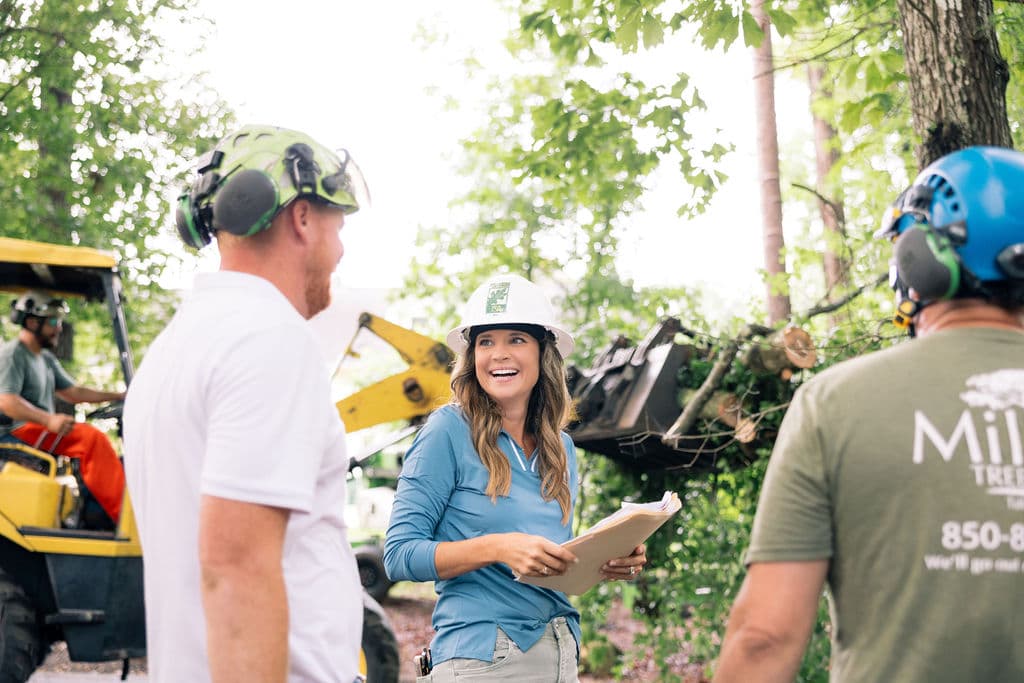
Hi, I’m Katie Watkins, an ISA Certified Arborist here in Tallahassee. I’ve been in tree care for 10+ years, and I work with homeowners every day who are trying to answer the same question before they call anyone:
“How much is this going to cost?”
Most tree companies dodge pricing online because it’s messy. Every tree is different. And they’re not wrong.
But homeowners aren’t wrong either. You’re not asking for a perfect number. You’re asking for a realistic range and an honest explanation of what moves the price.
So here it is: a detailed guide to what tree removal (and trimming and stump grinding) typically costs in Tallahassee, what affects the price, and what a professional estimate should include.
(If you want context on me: I’m a Sales Arborist at Miller's Tree Service and I am an ISA Certified Arborist and hold the ISA Tree Risk Assessment Qualification. You can check out my Instagram at KatieTheTreeLady or reach out at katie@millerstreeservice.com)
The pricing truth no one tells you
Tree work is priced the way we plan it:
- What equipment do we need? (climber? bucket truck? crane?)
- How long will it take? (hours = labor + overhead)
- How risky is it? (power lines, houses, fences, tight targets, size, species and structural stability)
- Can we access the tree efficiently? (gate width, slope, soft yard, setbacks)
A removal isn’t “cut tree, done.” It’s a controlled demolition with biology involved.
Tallahassee tree removal cost ranges by tree size
These ranges assume a typical residential property and a professional crew with insurance, safety systems, and proper equipment. Your exact quote will depend on access, targets, and complexity (we’ll cover those next).
1) Small trees (up to ~30 feet tall, 4-12” in diameter)
Typical range: $300–$900
These are the “straightforward” removals: smaller ornamentals, young pines, smaller hardwoods, and trees with room to work.
National pricing guides put small removals in the low hundreds. (The Spruce)
2) Medium trees (~30–50 feet, 12-24” in diameter)
Typical range: $900–$2,500
This is where many Tallahassee yards start to get interesting. Trees are bigger, heavier, and often closer to roofs, driveways, and fences. More work is done in sections instead of one drop.
National sources put mid-sized removals commonly in the hundreds to low thousands, depending on complexity. (The Spruce)
3) Large trees (~50–80 feet 24-36” in diameter)
Typical range: $2,500–$6,000
Large trees can still be “easy” if they’re in the open. But most large trees in neighborhoods are not in the open. They’re over a home, near a neighbor, or reaching toward power lines.
Consumer pricing sources show large tree removals can climb quickly, and they explicitly note taller trees can go far beyond the usual range. (Angi)
4) Extra-large trees (80+ feet36” + in diameter) or high-complexity removals
Typical range: $6,000–$15,000+
This category is less about height and more about constraints:
- tight drop zone
- heavy rigging
- major targets
- crane needed
- storm-damaged / hazardous tree
Some national guides mention tall or complex removals can reach five figures. (Angi)
A local reality check (why you’ll see wide ranges)
You might see “average” Tallahassee removal ranges online that look surprisingly tight (for example, one estimate site lists a typical band around the mid-$400s to mid-$600s). (Homeyou)
Those averages can be true for simple, smaller jobs—but they don’t describe:
- big pines and oaks over structures,
- removals requiring a crane,
- or back-yard jobs with terrible access.
That’s why I prefer size bands + the “price movers” below. That’s what helps you self-diagnose your situation.
What affects the price the most (in plain English)
If you remember nothing else, remember this:
Price = time + equipment + risk.
Here are the biggest levers.
1) Access: can we get equipment to the tree?
Access is the silent budget killer.
Two trees can be the same size and cost wildly different amounts because of access.
Things that raise cost:
- Narrow gates (common in Tallahassee neighborhoods)
- Long drag distance from the tree to the log truck
- Soft or wet ground (limits heavy equipment)
- Steep slope, tight turns, low rooflines, septic fields
A job that’s 3 hours with good access can become a full day when everything has to be moved by hand.
2) Targets: what’s under the tree?
Targets are anything you don’t want to hit:
- roof
- driveway
- fence
- pool screen
- neighbor’s property
- glass, cars, landscaping
If the tree can be dropped safely into an open area, it’s faster and cheaper.
If we have to dismantle it piece by piece and lower every section on ropes, it’s slower and costs more.
3) Power lines: you don’t “just cut near them”
Work near power lines changes everything:
- higher risk
- stricter safety rules
- sometimes coordination with the utility provider
In Florida, utilities manage vegetation around their infrastructure, but what they trim (and when) depends on the type of line and the utility’s program.
If a tree is in a line, that’s not a DIY situation, and it’s not a “buddy with a chainsaw” situation either.
4) Equipment needs: climber vs. bucket vs. crane
A good estimator is really building an equipment plan.
Climbing + rigging
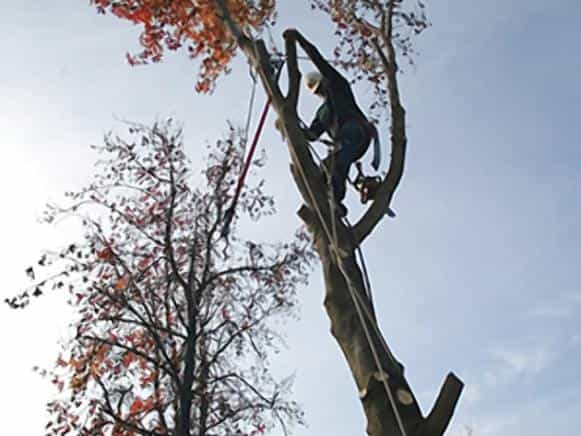
Most technical removals are done by a climber dismantling the tree in controlled sections.
Bucket truck / lift
Great when we can reach the canopy safely and get the truck into position.
Crane-assisted removal
A crane can be the safest, cleanest way to remove a high-risk tree—especially if it’s over a house or too compromised to rig confidently.
Crane work often has minimum time blocks and mobilization costs. You’ll see crane-related pricing references in the industry in the “thousands for the day” range.
5) Species and structure (yes, this matters)
Some trees are easier to dismantle. Some are heavier, more brittle, or more likely to have hidden defects.
In Tallahassee, we commonly deal with:
- tall pines (big vertical pieces, sometimes easier access)
- broad-canopy hardwoods (more limbs, more rigging, more brush)
The point isn’t the species name. The point is: structure changes time. Time changes price.
6) Height and diameter
Homeowners focus on height because it’s visible.
Arborists care about:
- height,
- canopy spread,
- and trunk diameter (bigger wood = heavier pieces = slower processing).
What’s included in a professional estimate (and what should be)
A real estimate is not just a number. It’s a scope.
Here’s what a solid tree removal quote should include:
1) The exact scope of work
- Which tree(s)
- Remove entire tree vs. remove only dead limbs vs. reduce canopy
- Any required pruning standards (especially near structures)
2) Disposal plan: what happens to the debris?
Options usually include:
- Haul-away included (most common)
- Leave wood on site (can reduce cost)
3) Stump grinding: included or separate?
Many homeowners assume stump grinding is part of removal. Often, it’s priced separately because it uses a different machine and has different access constraints.
4) Site protection and access notes
A good estimator will call out:
- gate constraints,
- where equipment will be staged,
- how we’ll protect turf/driveways,
- whether mats are needed for heavy equipment.
5) Safety and risk notes
Especially important if there are:
- power lines,
- dead/hazard trees,
- limited drop zones.
6) Permit guidance (when relevant)
In some cases, the City has protected tree rules and a tree permit process. (Tallahassee)
Also: Florida law limits when local governments can require permits/mitigation for removal on residential property if you have documentation from an ISA-certified arborist (or Florida licensed landscape architect) that the tree poses an “unacceptable risk.” (Smart Surfaces Policy Tracker)
(That’s not legal advice—just a heads-up that rules exist and a good arborist should help you navigate them.)
7) Proof of insurance
If a company can’t provide insurance documentation, don’t hire them. Period.
Tree trimming (pruning) cost ranges in Tallahassee
Trimming is where pricing gets misunderstood the most, because the words get mixed:
- trimming
- pruning
- thinning
- raising
- reduction
- deadwood
- clearance
Pruning is priced by the same model: time + access + risk.
Typical ranges you’ll see:
- Many national guides show pruning commonly in the hundreds per tree, rising to $1,000+ for large, complex work. (The Spruce)
- A Tallahassee cost source lists a four-person crew hourly rate in the ~$600 range.
In practice, your trimming quote depends on:
- how much material is coming out,
- whether we’re climbing or using a lift,
- the cleanup requirement,
- and proximity to targets and lines.
Stump grinding cost ranges (and how stump pricing works)
Stump grinding is usually priced by:
- stump diameter (in inches), or
- a flat minimum + size adjustment, or
- a “first stump / additional stump” schedule
Typical ranges you’ll see:
- National: around $131–$438 is commonly cited for a single stump job. (LawnStarter)
- Some companies charge $2–$5 per inch, often with a minimum. (LawnStarter)
What changes stump grinding cost:
- Can the grinder reach the stump easily?
- Do we need to grind deeper for replanting or hardscape?
- Are there rocks, edging, irrigation, or utility concerns?
- Are we removing the chips or spreading them out?
A fast way to “guess your tier” before you call anyone
If you want a quick self-check, ask:
Can it be dropped in one piece safely?
If yes: lower cost.
Is it in the backyard with a narrow gate?
If yes: higher cost.
Is it over a roof/driveway/fence/power lines?
If yes: higher cost.
Is it dead, storm-damaged, or leaning?
If yes: higher cost (and sometimes crane).
That’s it. That’s the game.
How to get a quote that’s accurate (and comparable)
If you’re collecting multiple estimates (you should), make sure every company is bidding the same scope.
When you talk to an arborist, ask:
- Is haul-away included?
- Is stump grinding included? If not, what is it?
- How will you access the tree?
- Will you use a climber, lift, or crane?
- What are you protecting on site?
- Are permits or utility coordination likely?
- Can you provide proof of insurance?
You’ll learn a lot from how clearly they answer.
If you want, I’ll help you sanity-check your situation
If you tell me:
- approximate height (or a photo next to the house),
- how close it is to structures,
- whether there are power lines nearby,
- and whether it’s front yard or back yard,
…I can tell you which pricing tier you’re likely in and what the biggest drivers will be.
That’s usually enough to turn “I have no idea what this costs” into “I know what questions to ask, and I know when a quote makes sense.”
(And yes—unlike most competitors, I’m comfortable talking about price. Because trust starts there.)
Free Tree Disease Assessment