Emergency Tree Services: What to Do After a Storm in Tallahassee

A summer storm passes through Tallahassee. The wind dies down. You look out the window and see it: a large pine across your back fence, or a live oak branch the diameter of your forearm suspended in the canopy, held up by nothing more than a strip of bark.
What you do in the next sixty minutes matters more than most people realize.
In my work as an arborist across Leon County, the calls I receive after significant storms follow a recognizable pattern. Some homeowners are methodical and safe. Others walk into genuinely dangerous situations because they underestimate what storm-damaged trees can do. The difference, usually, comes down to one thing: understanding which types of storm damage require immediate professional intervention and which can wait until morning.

Step One: Do Not Go Outside Yet
The instinct after a storm is to assess. Resist it. Before you step outside, look carefully at what's visible from inside: whether any trees or branches are in contact with power lines, whether there are hanging limbs directly above walkways or entry points, and whether any structural damage to your home involves tree material.
Downed power lines are the most acute hazard, and they do not always arc visibly. If a tree has fallen onto or near lines you cannot positively identify as de-energized, treat the entire area as a live electrical zone and call your utility provider before approaching. Have both TECO and the City of Tallahassee utility numbers accessible before hurricane season begins each year — not after a storm, when finding them takes time you may not have.
The Three Tiers of Storm Damage
Not all storm damage carries equal urgency. When I assess post-storm conditions, I categorize damage into three tiers that help prioritize response.
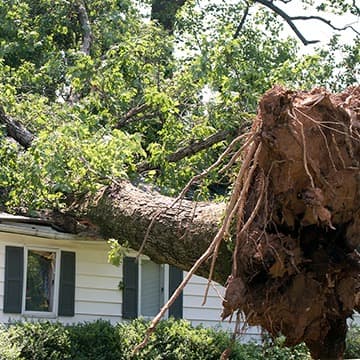
Tier 1 — Immediate Emergency: Trees or large branches in contact with utility lines; suspended hangers in the canopy directly above occupied areas; trees that have partially failed and remain structurally unstable; root-plate upheaval on large trees adjacent to buildings. These situations require a professional emergency arborist, not a delay until business hours.
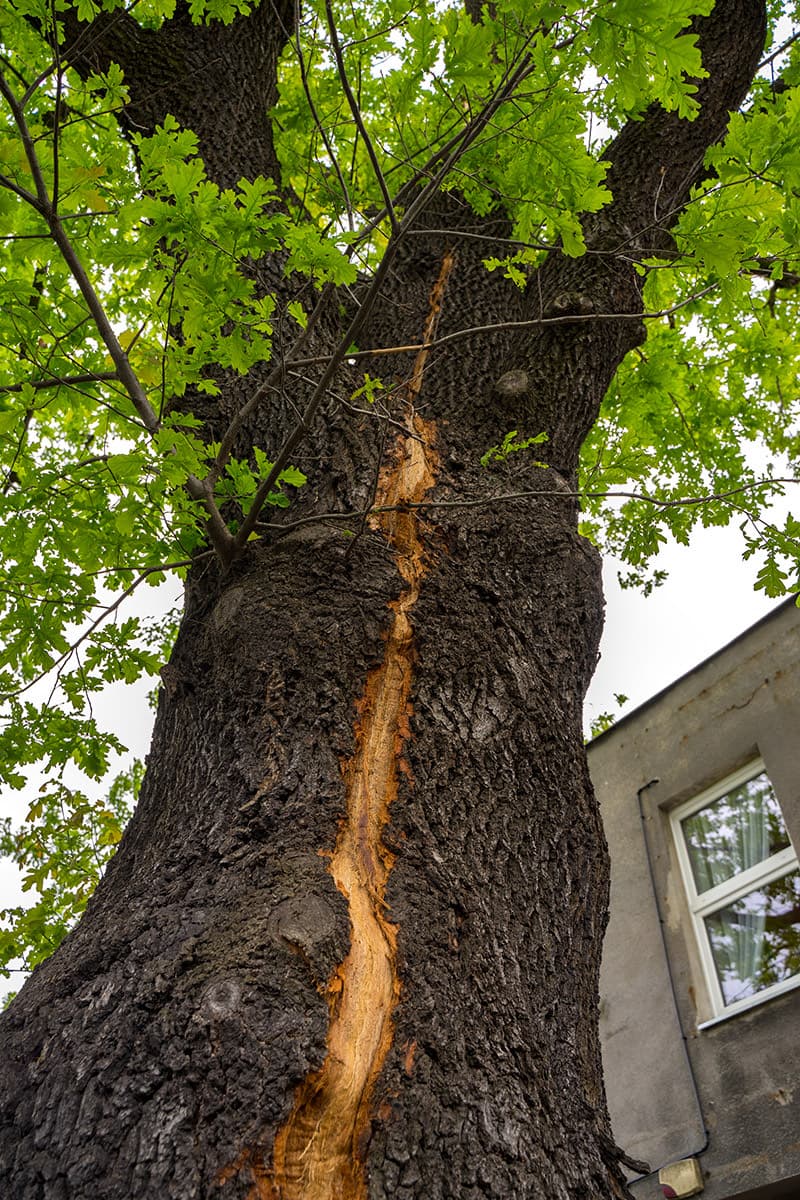
Tier 2 — Urgent but Not Immediate: Clean fallen trees away from structures; large branches grounded but not suspended; split crotches that have partially separated. These should be addressed within 24 to 72 hours but don't warrant a midnight call. Document thoroughly and contact a certified arborist first thing in the morning.
Tier 3 — Routine Post-Storm Cleanup: Broken small branches, displaced surface debris, minor pruning to address superficial crown damage. These can often wait days or even weeks and may be manageable without professional assistance depending on scale.
Document Before You Clear
Before any removal work begins — whether performed by a contractor or yourself — photograph and video document the damage comprehensively. Capture the fallen tree, the impact zone, any damage to fencing, vehicles, or structures, and if possible, any pre-existing conditions on the tree such as visible decay or prior storm damage. This documentation is the foundation of any insurance claim and, in some cases, of legal proceedings if the tree originated on a neighboring property.
Florida's laws regarding tree liability and neighbor responsibility are nuanced. A healthy tree that falls during a weather event beyond reasonable anticipation is generally treated differently from a visibly diseased tree that a property owner failed to address. The photographic record you create immediately after the storm is often the most consequential evidence in that determination.
Why the First Company You Call Matters
After major storms, the Tallahassee market reliably fills with out-of-state crews offering rapid-response tree removal. Some are competent. Many are not. Warning signs worth knowing: no local business address, no verifiable certificate of insurance, no ISA-certified arborist on staff, pressure to sign contracts before a written estimate is provided, and refusal to supply references.
Beyond quality and safety concerns, there is a specifically arboricultural reason to insist on a certified arborist for significant storm work. Storm-damaged trees frequently present situations where the decision between removal and preservation is genuinely consequential — for your property value, your long-term landscape, and the health of adjacent trees. An ISA Certified Arborist can make that determination accurately. A general tree-clearing crew cannot.
Saving Storm-Damaged Trees
One of the most important things I tell homeowners after a storm is that not every damaged tree is a dying tree. Trees with split crotches can sometimes be successfully cabled and braced. Trees that have partially uprooted can, in certain circumstances, be uprighted and stabilized if root damage is not extensive. Trees with significant crown loss can sometimes recover if the root system and lower trunk remain structurally sound.
The determination requires assessment, not assumption. I've seen trees written off after storms that became thriving specimens again within three growing seasons. I've also seen trees that looked largely intact reveal themselves, under formal evaluation, to be too structurally compromised to retain safely. Neither outcome is predictable from casual observation.
If you've experienced storm damage to your trees and are uncertain about what needs to go and what can be saved, contact Miller's Tree Service. We offer emergency response throughout the Tallahassee area and will provide a professional assessment of every tree on your property following a significant weather event.
About the Author
Katie Watkins is a Sales Arborist at Miller's Tree Service in Tallahassee, FL, specializing in tree health care and helping customers make informed decisions about the long-term well-being of their trees. She holds her ISA Certified Arborist credential (FL10270A) and is Tree Risk Assessment Qualified (TRAQ) by the International Society of Arboriculture. Katie has been part of the Miller's team since 2015. Follow her on Instagram at @katiethetreelady.
Free Tree Disease Assessment