Here's the statistic that surprises every homeowner:
Per the ISA Certified Arborist Study Guide, approximately 70 to 90 percent of all tree health problems are caused by abiotic factors — compaction, drought, moisture extremes, mechanical injury, herbicide drift, poor species selection, construction damage. Insects, mites, and pathogens are the cause in a small minority of cases. Even when they're present on a declining tree, they're usually opportunists exploiting a tree already weakened by something else.
This is why "what disease does my tree have?" is almost always the wrong opening question. The right one is: "what's actually wrong with this tree?" — and answering it follows a systematic diagnostic process, not a guess at the most visible symptom.
Biotic vs. Abiotic: The First Diagnostic Lever
The first thing a real diagnostic visit does is determine which category we're in.
Biotic agents — fungi, bacteria, viruses, insects, mites, mammals — tend to:
- Spread from one tree to another
- Produce nonuniform damage patterns (some branches affected, others not; some leaves spotted, others healthy)
- Sometimes leave signs (the agent itself, or its byproduct: fruiting bodies, frass, exit holes, mycelium)
Abiotic agents — drought, flood, soil compaction, herbicide drift, lightning, temperature extremes, mechanical injury, nutrient deficiency — tend to:
- Affect multiple species in the same area
- Produce uniform damage patterns across an entire tree or across many trees
- Leave no biological evidence of a causal organism
If five different species in your neighborhood are all showing the same yellowing pattern, you're looking at something abiotic — a soil problem, drought stress, an irrigation issue. If one tree in a row of identical neighbors is the only one declining, biotic agents move higher up the list.
The ISA Six-Step Diagnostic Process
The systematic framework arborists are trained against:
1. Accurately Identify the Plant
Many insects and diseases are host-specific. Pine bark beetles attack pines. Oak wilt attacks oaks. Hypoxylon canker attacks oaks. Bacterial leaf scorch hits oaks, elms, sycamores. Some certain symptom appearing on a pine and the same symptom on a magnolia often have completely different causes.
Step one: what species is this? See our Tallahassee tree ID guide for the species we see most often locally.
2. Look for a Pattern of Abnormality
Compare the affected tree to others on the site, especially the same species in the same conditions.
- Are the symptoms in a uniform pattern (whole canopy yellowing, whole tree thinning) — abiotic stress is likely?
- Are the symptoms in a nonuniform pattern (one branch dying back, leaf spots in clusters) — biotic agents are more likely?
- Is the tree of concern the only one affected, or are similar species nearby showing similar symptoms — abiotic moves up?
The "compare to neighbors" step is doing real diagnostic work. A homeowner usually skips it. We don't.
3. Carefully Examine the Site
What's actually happening around the tree:
- Light levels (recent canopy changes from neighbor's tree removal? building construction blocking sun?)
- Soil characteristics and water availability (recent irrigation changes? a leak? a paving project that's altered drainage?)
- Recent construction within the drip line (driveway extension? trenching? grading?)
- Hardscape contact (compaction from foot traffic, parking, vehicles?)
- Microclimate (heat reflection off a new pool deck? wind exposure from a recent tree removal nearby?)
- Chemical exposure (deicing salt? herbicide drift? wood preservative leaching?)
A tree that started declining three years after a major yard project tells you something a tree that started declining last spring doesn't.
4. Note Color, Size, and Thickness of Foliage
The leaves are usually where homeowners first notice a problem — but the leaves are often the visible end of an underground or vascular problem. The ISA Study Guide lists what to look for:
- Chlorosis (yellowing) — patterns matter: interveinal (iron/manganese availability), uniform (nitrogen deficiency or root stress), marginal (drought or salt)
- Necrosis (dead tissue) — scorch on margins (drought, salt, root damage), spots (fungal/bacterial), blotches (various)
- Defoliation — premature drop (root or vascular problem), uniform drop (deciduous timing or stress), patchy (biotic)
- Undersized leaves — chronic stress, root damage, drought
- Twisted or curled foliage — viral infection, insect feeding, herbicide exposure
- Early autumn color — root problems, girdling roots, stress
Many disorders first apparent in the foliage actually originate in the roots or vascular system. The canopy is showing you the end of the story. The root system is where the story started.
5. Check Trunk and Branches
Working up the tree:
- Bark condition — discoloration, oozing (canker disease, bacterial wetwood), loose bark, missing patches
- Cankers — sunken or raised wounds where bark has died
- Borer evidence — exit holes (round = beetles; D-shaped = certain wood borers), frass (sawdust-like material — ambrosia beetles produce distinctive "toothpicks" of compressed frass), exit holes lined with sap
- Watersprout proliferation — stress response, often indicating root problems or recent crown loss
- Fungal fruiting bodies — conks or mushrooms on the trunk are a definite indicator of decay
A useful trick the ISA framework cites: measure the distance between annual terminal bud scale scars on the most recent few years of growth. Steady scar spacing = steady growth. Decreasing spacing year over year = decline is in progress, and you can sometimes pinpoint the year it started.
6. Examine the Roots and Root Collar
The ISA Study Guide calls this "the most frequently overlooked portion of the tree in the diagnostic process" — and the most consequential. Most decline in urban trees starts here.
What we look for:
- Buried root flare (soil or mulch piled against the trunk)
- Girdling roots at the base of the trunk
- Root collar condition — decay, oozing, bark loss
- Fungal fruiting bodies at the base or on surface roots (Ganoderma, Armillaria, etc.)
- Soil condition — compacted, saturated, dry, freshly disturbed
- Fine root health in shallow excavation — healthy roots are light-colored inside, flexible, and firm. Brown or black roots, a sour smell, or bluish-gray soil indicate dead roots and anaerobic conditions.
Most root-zone problems are visible in 10 minutes of looking. They just have to be looked at.
The "Decline Disease" Concept
For trees that have been declining for years rather than weeks, the ISA framework offers a useful diagnostic lens: the decline disease model.
A decline disease is the gradual deterioration of a tree from multiple interacting factors, not a single cause:
- Predisposing factors (chronic): old age, poor site selection, compacted soil, restricted root volume, prior construction damage
- Inciting factors (acute trigger): drought year, defoliation event, lightning strike, severe pruning, a hurricane
- Contributing factors (opportunists): bark beetles, canker fungi, root rot pathogens that arrive after the tree is already stressed
The diagnostic conclusion isn't "the tree has bark beetles." It's: what predisposed the tree, what inciting event tipped it over, and what's the opportunist now finishing the job? Treating only the contributing factor — say, with insecticide for the beetles — without addressing the predisposing and inciting conditions almost always fails.
Signs vs. Symptoms
One more vocabulary point the ISA Study Guide stresses, because it matters:
- A symptom is the tree's response to the problem: chlorosis, wilting, dieback, leaf spot, defoliation
- A sign is direct evidence of the causal agent: a fungal fruiting body, insect frass, the insect itself, mycelium under the bark
Diagnoses are stronger when supported by signs, not just symptoms. Many tree problems produce similar symptoms. The signs are what separate them.
A tree showing leaf scorch could be drought-stressed, salt-damaged, bacterial leaf scorch infected, or root-damaged — same symptom, four different causes. The signs (and the rest of the diagnostic context) are what tell you which.
What This Looks Like in Practice
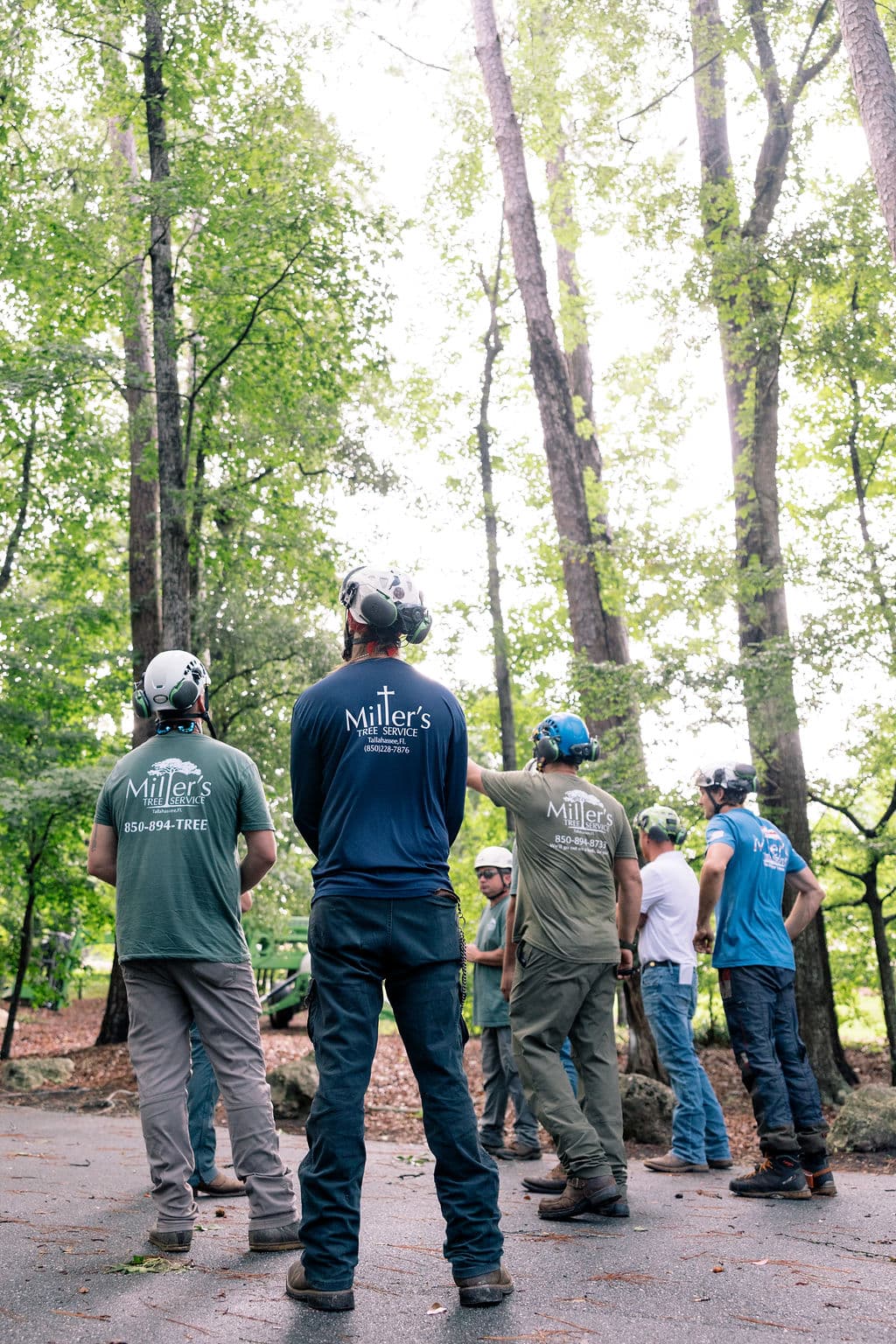
When a Miller's arborist arrives at your sick-tree visit, the conversation we have is not "what disease does it have?" It's:
- What species, and how old?
- When did you first notice symptoms? What changed in the year or two before?
- Has there been construction, paving, grading, or trenching in the last 5–10 years?
- What's the irrigation pattern? When was it last changed?
- Are other trees on the property or nearby showing similar issues?
- Can we look at the root flare and root collar?
The diagnostic work is mostly the conversation and the site walk. The "what's wrong" answer comes out of the framework, not out of guessing at the most prominent symptom.
If your tree is in decline and you want a real diagnostic visit instead of a removal quote, our free tree disease assessment starts here. Most of what we find is fixable. Most of it isn't a disease.