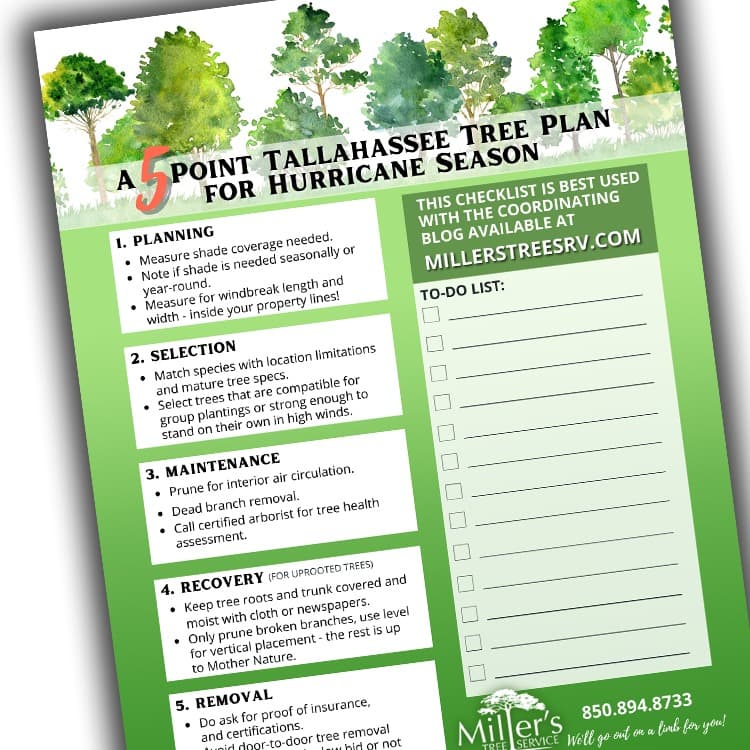
At Miller's Tree Service, we have seen firsthand what hurricanes and tropical storms can do to Tallahassee's trees -- and to the homes, fences, and vehicles beneath them. After decades of serving the North Florida community, we have distilled our storm preparation expertise into a practical five-point checklist that any homeowner can use to reduce their risk before hurricane season begins on June first. This is not theoretical advice -- it is built from real experience cleaning up after major storms and knowing exactly which problems could have been prevented.
Point one: conduct a full property inventory. Walk your entire yard and document every tree, noting its species, approximate size, condition, and proximity to structures. Pay particular attention to trees within falling distance of your home, garage, power lines, and vehicles. This inventory becomes your master reference list and helps you communicate efficiently with an arborist about which trees need attention. Point two: schedule professional pruning for high-priority trees. Dead wood removal, crown thinning, and structural pruning are the most effective storm mitigation measures available. Wind passes through a properly thinned canopy rather than catching it like a parachute. Focus your pruning budget on the trees closest to targets -- your house, driveway, and utility connections.
Point three: assess root zone health across your property. Trees with compromised root systems are the ones most likely to topple in a storm, and root problems are often invisible until failure occurs. Signs of root trouble include soil mounding or cracking near the trunk base, fungal growth on surface roots, and any history of construction or grading activity that may have severed roots. Mulching to maintain soil moisture and reduce compaction helps maintain root health over time. Point four: identify and address structural defects. Codominant stems, included bark at branch unions, large cavities, and cracks in major limbs are all potential failure points during high winds. Some of these can be managed with supplemental support systems like cabling and bracing, while others may warrant the removal of specific limbs or, in some cases, the entire tree.
Point five: establish your emergency plan. Know which trees pose the greatest risk, have your tree service contact information readily accessible, and make sure your homeowner's insurance is up to date with adequate coverage for tree damage. After a major storm, professional tree services are inundated with calls, and response times can stretch for weeks. Homeowners who have an existing relationship with a reputable company and have already had preventive work done are typically served more quickly. Miller's Tree Service offers comprehensive pre-hurricane evaluations that walk through all five points on your specific property, giving you a detailed action plan and the peace of mind that comes from knowing you have done everything reasonable to protect your home and family.