A homeowner calls and asks for a pine to be "shaped up."
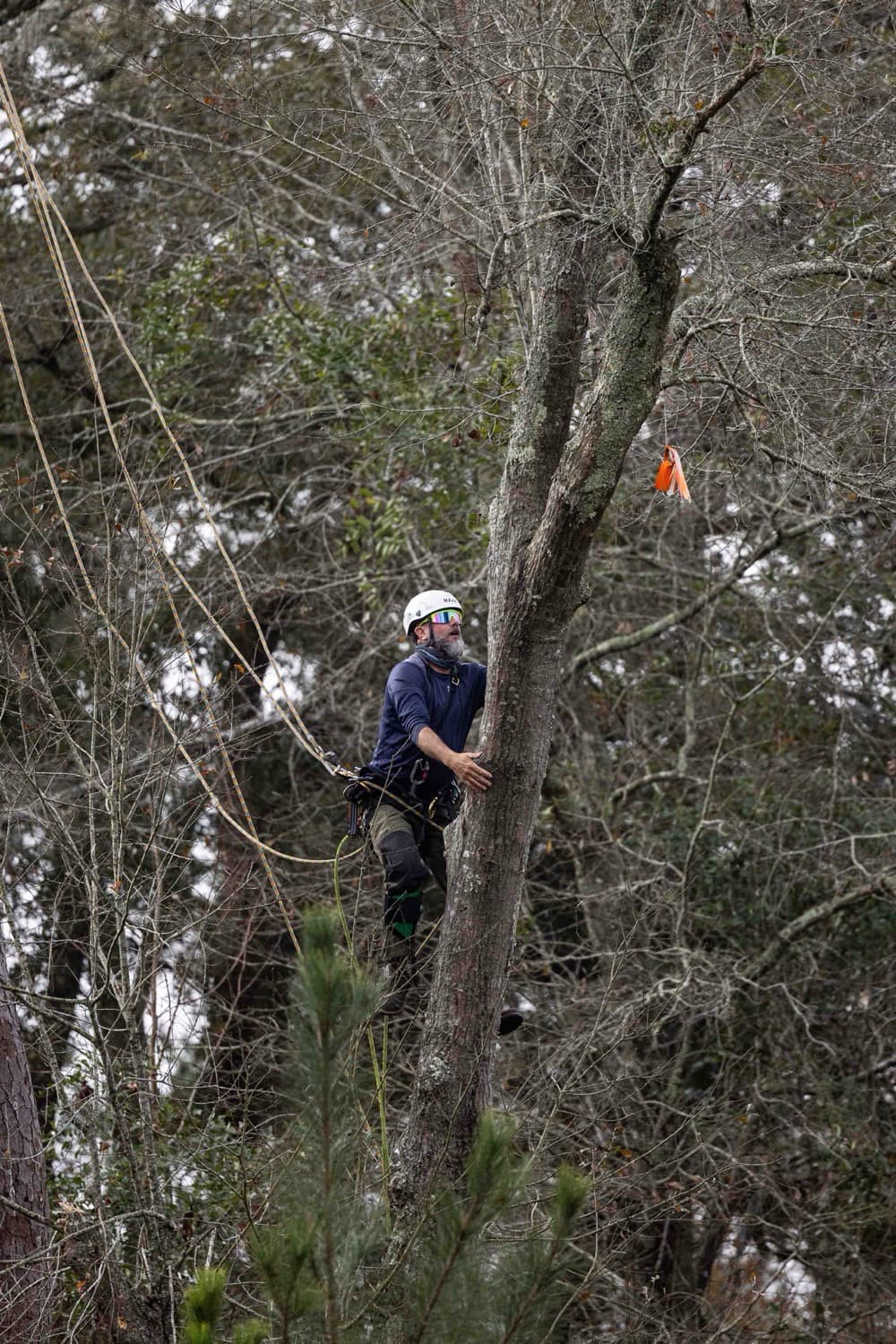
The pine in question is a 70-foot loblolly. The branches the homeowner wants reduced are 30 feet in the air and 8 inches thick.
This is where the conversation has to start: pines do not respond to pruning the way oaks and other broadleaf trees do. The reflexes that work on a live oak — reducing back to a lateral, thinning the interior — mostly don't work on conifers. Pruning a pine the wrong way creates dead branches, dead sections of canopy, or, on a bad day, a dead tree.
Here's what's actually going on, and what does work.
Why Pines Are Different
Live oaks have latent buds scattered through their wood. Cut a live oak branch back to a stub and it will often sprout new growth from the stub itself. Reduce a live oak branch to a smaller lateral and the lateral takes over and grows out.
Pines mostly don't do this.
The ISA Certified Arborist Study Guide puts it plainly: on most conifers, reducing branch length beyond the zone of live foliage usually results in branch death unless the species is capable of sprouting — and most pines, firs, and spruces are not. New growth on pines comes from the buds at the tips of existing branches, not from buds along the woody interior.
Translation: the cut your tree guy makes "to shape it up" usually kills the branch below the cut. Not immediately. Slowly. Over a season or two. The branch goes brown from the cut backward to the next live whorl, then drops.
What Actually Works on Pine Trees
Three things, mostly.
1. Removing Dead, Dying, or Diseased Branches
This is the most common reason to touch a pine. Dead branches in the canopy are a hazard and an entry point for insects and pathogens. Bark beetles in particular are drawn to stressed pines, and dead wood is where they start. Removing dead branches is straightforward, low-risk, and worth doing — especially before storm season.
2. Structural Pruning of Young Pines
The thing pines have in common with broadleaf trees: when they're young, they benefit from structural pruning. A young pine that has lost its dominant leader to storm damage or insect injury often develops two or three competing upright stems — the same codominant-stem problem oaks have, except harder to fix later because pines don't compartmentalize well.
The right time to address a forked pine leader is in the first 5–10 years of the tree's life. Pick one stem as the new leader, subordinate the others, and the tree grows back into proper form. Wait twenty years and the structural defect is permanent.
3. Candle Management on Ornamental Pines
This is a specialty technique and it's the one pruning practice that pines genuinely respond to. In spring, pines push new growth as upright shoots called candles before the needles open. Shortening the candles — pinching or cutting them back by half before the needles harden — reduces stem elongation for that year and produces denser, more compact growth.
This is how Japanese gardeners control mugo pines and how a few specimen ornamentals get kept to size. It is not how you reduce a 70-foot loblolly in someone's backyard. Candle work has to happen in a narrow window in spring, and it has to be done every year. Most homeowners don't want either.
What Doesn't Work — and What People Try Anyway
Topping a pine. Same six problems as topping any tree (starvation, decay, weak regrowth, rapid regrowth, decline, disfigurement) plus the conifer-specific problem that the cuts don't sprout new foliage. A topped pine becomes a pole with a dead-looking tuft on top.
"Lifting" a pine by removing lower limbs to gain clearance. You can do this, carefully, to a point. But pines naturally self-prune their lower branches as they grow; the ones still on the tree are usually still photosynthetically useful. Strip them off too aggressively and the tree loses energy reserves and develops poor taper.
Crown reduction by cutting back to small laterals. The lateral has to be substantial — at least one-third the diameter of the branch being reduced — for the reduction cut to work on any species. On pines, even that often fails because the conifer simply can't sustain the branch from the smaller lateral alone. Branch death follows.
Pine-Specific Storm Prep in Tallahassee
If you have loblolly or slash pines near your house, the pre-storm question is rarely "should we prune this?" It's usually one of three other questions:
-
Is it healthy? Stressed pines — drought-weakened, beetle-infested, lightning-struck — are the ones that fail in storms. A pine that looks healthy and has solid live canopy from top to bottom usually does fine.
-
Is the root plate solid? Pines fail by uprooting more often than by snapping. Saturated sandy soil during a hurricane and a shallow root system are the recipe. Recent construction near the tree, paving over the root zone, or trenching for utilities all compromise this.
-
Is its fall zone clear of what matters? A 70-foot pine 80 feet from your house is a different conversation than the same pine 30 feet away.
For pines in problematic locations, proactive removal is almost always cheaper than emergency removal after they've fallen — and far cheaper than the roof repair. See our storm damage hub for the broader pre-storm framework.
When to Call
If you have a pine you're worried about, the right first move isn't a pruning quote. It's a hazard assessment. Our tree hazard inspection service evaluates the actual risk — root plate, trunk soundness, lean, canopy health — and tells you whether the right intervention is pruning, removal, or nothing at all.
For pine pruning that's genuinely warranted — dead wood removal, young-tree structural work, or careful clearance — our tree pruning service is built around the conifer-specific principles above. We won't reduce your loblolly by cutting it back to nothing, because the loblolly won't survive it.